We wanted to give you an update on some recent events reported by WAG. Lynn has had a rough holiday season with the increased poaching, the loss of her friend and cohort Austin and having just recovered from another bout of malaria. How she keeps smiling is beyond me.
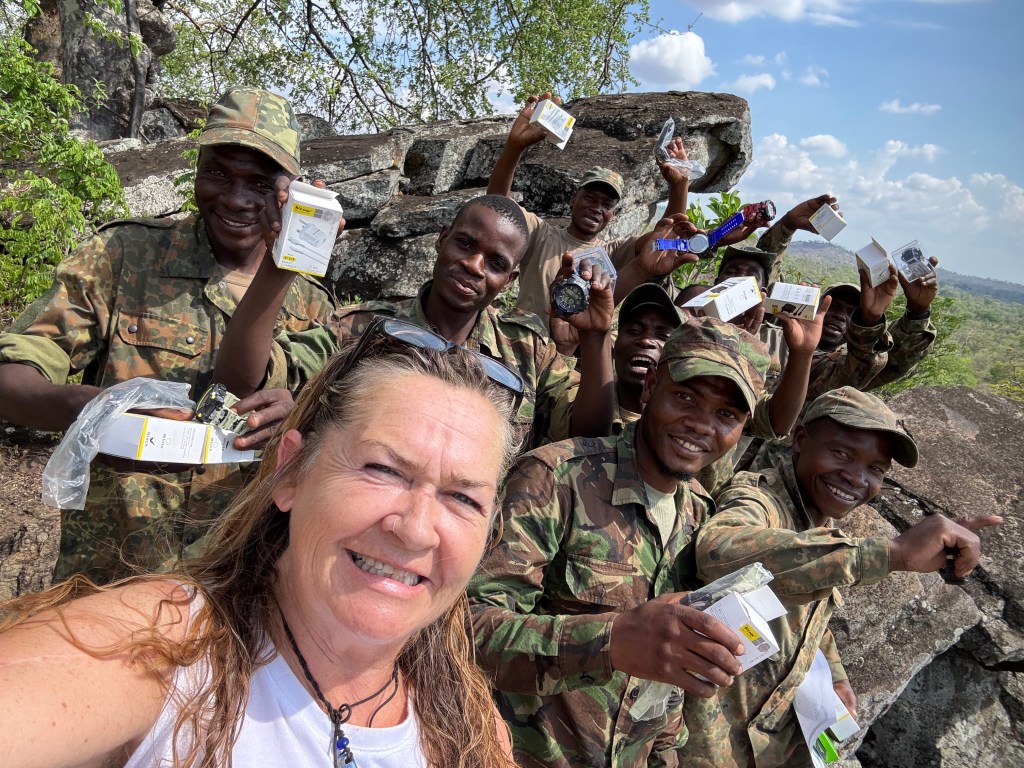
She sent a couple of pictures of her and the rangers after they received the Christmas bonus sent by Elefence and the gifts that the rangers received from WAG.
Lynn reported that they have planted 52,000 seedings in two sites previously deforested in the reserves. They arrested an ivory dealer and sized the ivory and arrested two charcoal burners cutting wood in the reserves. They are still trying to chase three bulls who left the reserve back into the forest. UPDATE Three people were killed last week by elephants from the reserve, a mother and infant child and a man trying to protect his garden. Elefence is working on securing a grant to complete the fence to keep wildlife in the reserve.
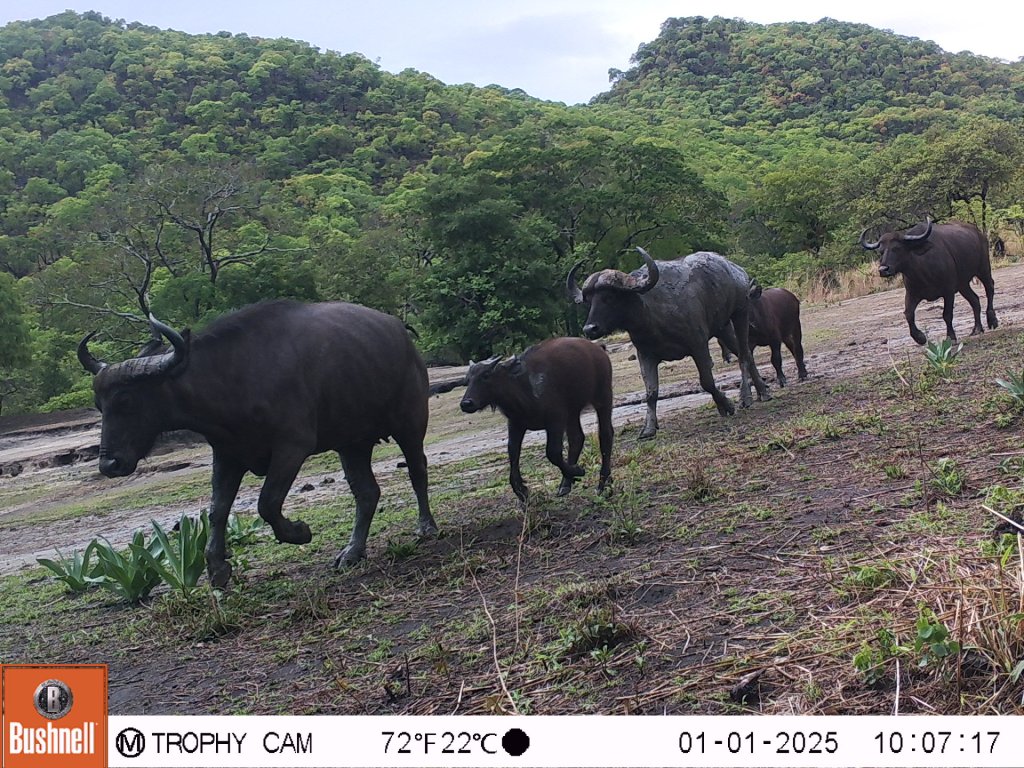
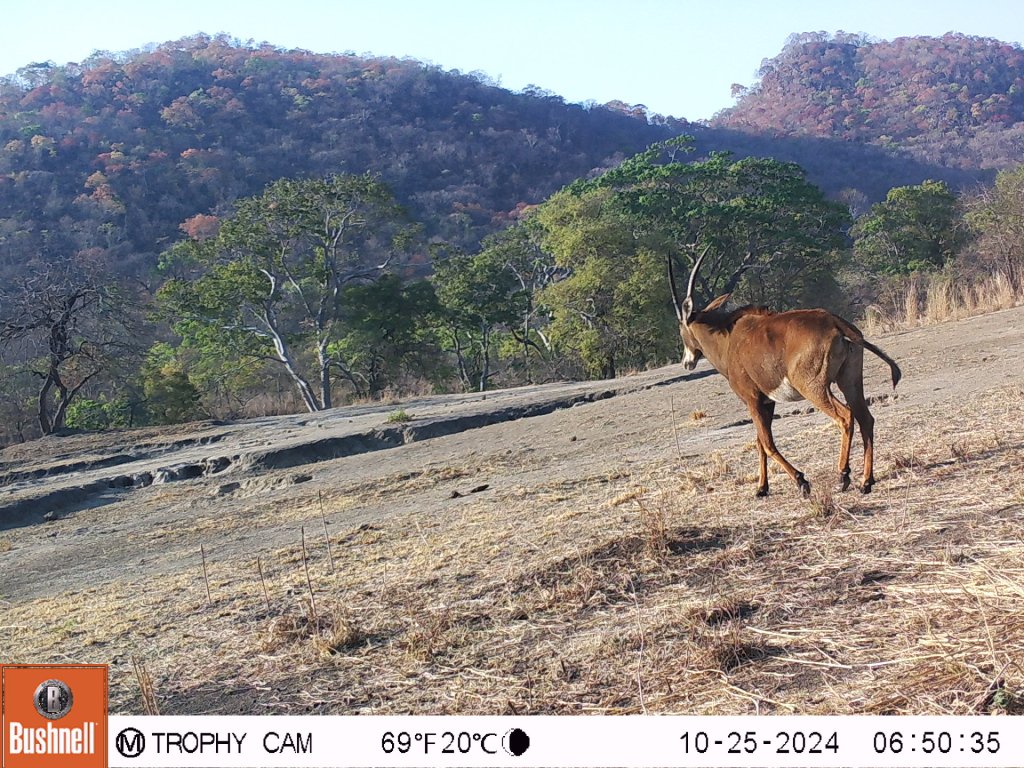
Below are photos from of the camera traps WAG sets out. The camera traps trigger a photo when movement is sensed nearby. WAG use the photos to keep track of animals within the reserve as well as people in the forest who should not be there. The background in the photos is a flat pan that has salt and mineral deposits. All types of animals visit it to get the minerals they need to maintain their health. It is a great place to get shots of all sorts of animals.
Elefence is planning to supply some additional camera traps to allow WAG to expand its coverage in the reserves.
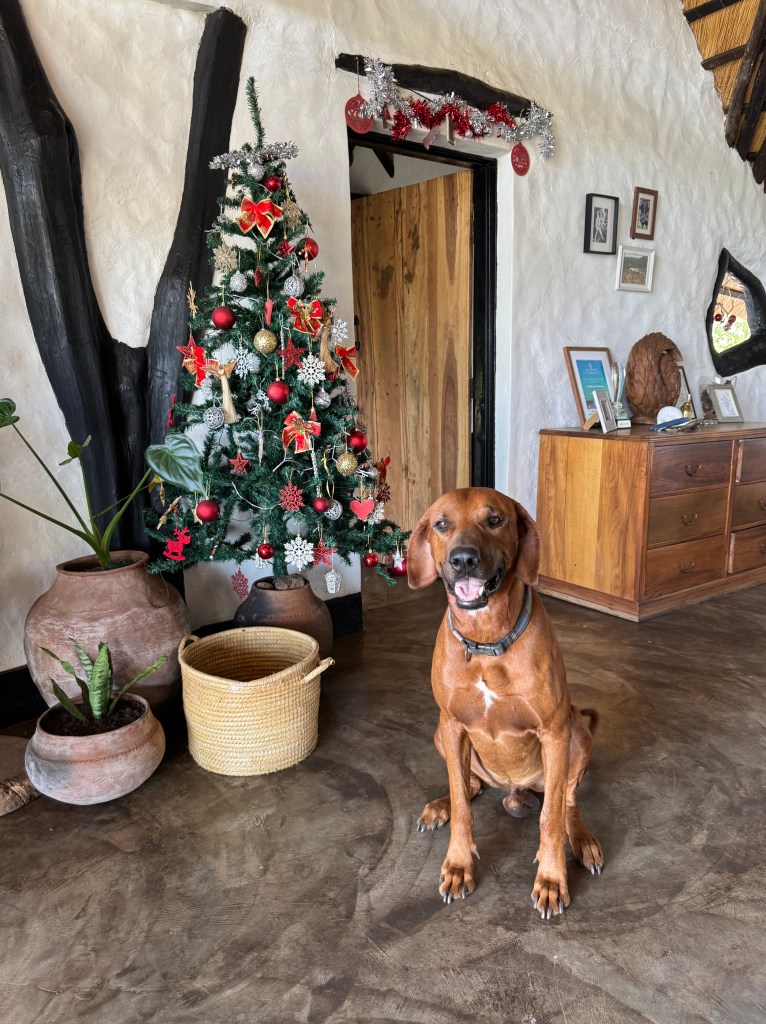
Finally a picture of Lynn’s canine companion Tarik by the Christmas tree in the lodge. Tarik means star which you can see on his chest. He is a Rhodesian Ridgeback and very friendly.
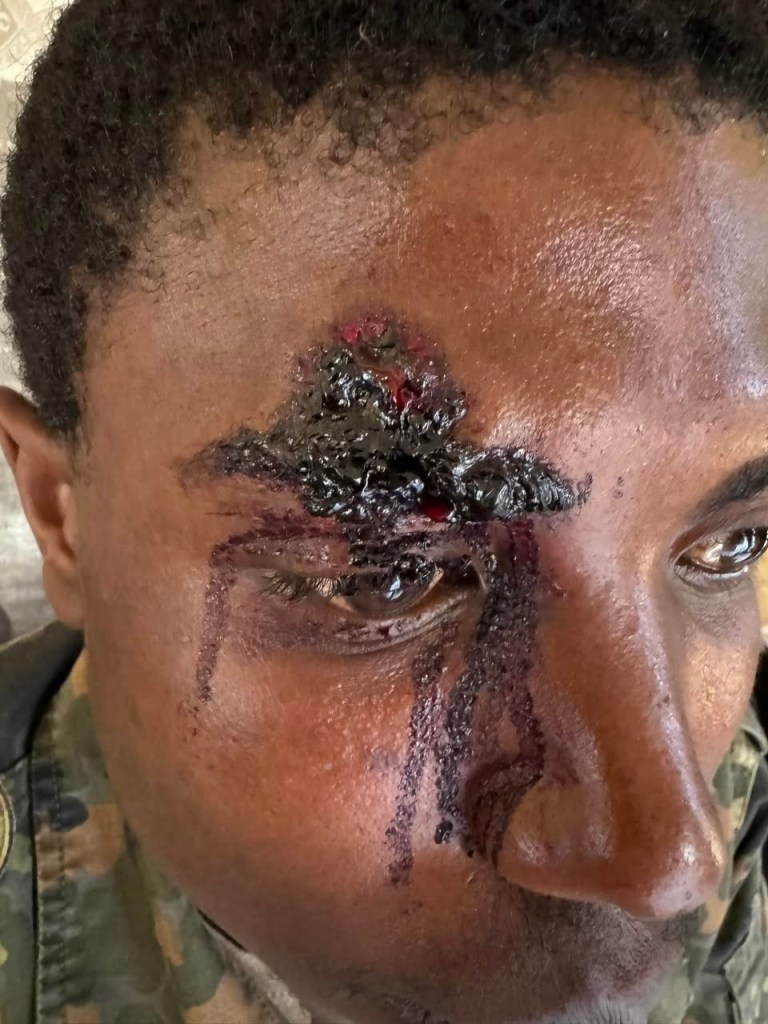
A wounded ranger is pictured after a recent encounter with a gang of poachers. Fortunately it was only a flesh wound. But a WAG ranger was killed by a poacher a few years ago and another ranger was recently killed by an elephant while a third was gored by a cape buffalo. A forest ranger’s job is one of the most dangerous in the world. About 150 rangers worldwide die each year protecting wildlife according to the Thin Green Line (TGL) Foundation, an international charity.
Conflicts with poachers are responsible for 50 to 70% of ranger deaths on the job, according to data from TGL. The rest are attributed to daily challenges such as hazardous environments and dangerous animals – especially elephants and Cape buffalos.
Africa is know for its vast nature reserves, ecotourism and educational approach to conservation. Unfortunately, armed poachers and militant gangs are targeting African rangers. In Africa, an astounding 82% of rangers said they have faced a life-threatening situation in the line of duty.
WOULD YOU TAKE ON THIS JOB FOR $3 A DAY? This is why Elefence, in partnership with Malawi’s Wildlife Action Group (WAG), works to find financial support for the 51-man strong team of rangers. Elefence and WAG initiated a Ranger Cash Reward Program for various rangers who’ve shown meritorious work in the field protecting elephants and other highly endangered wild animals.
Keep in mind, these men struggle to feed their families while they are on patrol in the forest 25 days a month living in primitive conditions with no access to emergency medical care. If badly wounded in the field their chances of survival are slim. There are no medics on the patrol teams. ( Our pioneer Elefence trustee, Max Seymour, was a battlefield medic in Viet Nam, and knows well how crucial immediate emergency care is in the field.) {see Elefence team bios on our website, http://www.elefence.org.}
Elefence has just given the 51 rangers Christmas bonuses of $10 each. It is humbling and emotionally gripping to see these men so thrilled to receive such a modest amount. We wish it could be more , but we can only give what is contributed since Elefence and WAG are small organizations, continually and frustratingly, challenged to find funding. Sad that in a world run by billionaires these brave rangers who work to save fragile ecosystems and wildlife for the world’s future, scramble for crumbs.
Without funding, the rangers of Thuma and Dedza-Salima forest reserves will not be able to continue their work. If you are interested in helping these brave men, please contact us directly or make a contribution directly on the Elefence website. If you have donated recently we thank you -and be assured that donations go directly to our efforts in Malawi. Elefence International Inc. is a USA registered 501(c)3 charity and all contributions are tax-exempt.
Please remember to frequently check our blog for more stories about the rangers and their ongoing work to protect the forest and its wildlife
Merry Christmas everyone from ELEFENCE and WAG. Thank you for reading.
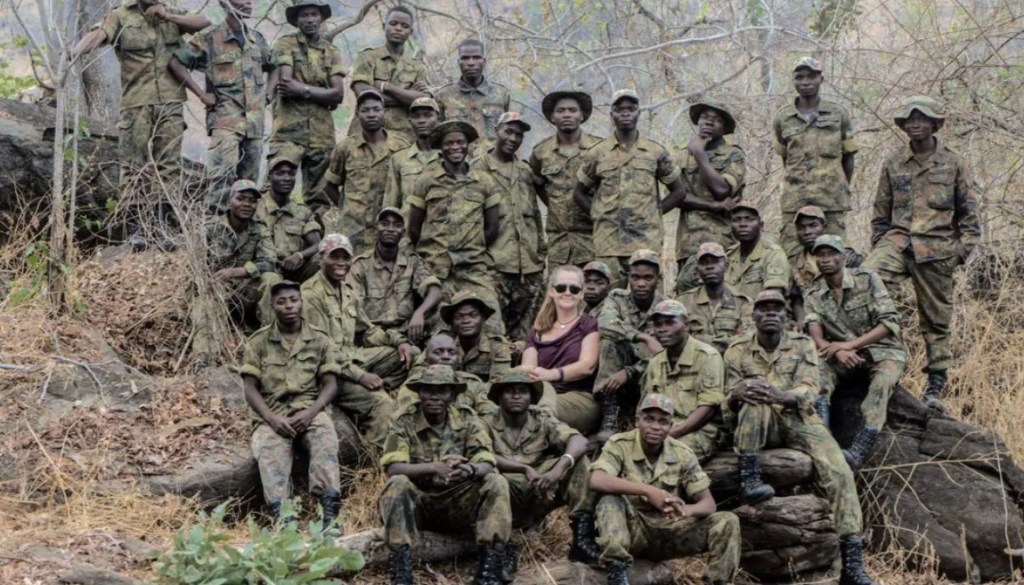
Lynn Clifford, WAG Field Officer Of Thuma and Dezdza-Salima Forest Reserves, is seen surrounded by her brave anti-poaching rangers who have recently expanded to 51 members. Thanks to Lynn and her team the Thuma Forest Reserve is now the most protected forest in Malawi. Work continues in the Dedza-Salima Reserve.
Poaching incidences are on the increase in Thuma Forest (Malawi) especially poacher hunting with dogs, bows, arrows and spears! Last week two suspects were arrested and this morning our brave anti-poaching rangers arrested 3 more, one being one of the most notorious poachers from dedza who has been a very large thorn in our side all of this year! A second offender! All suspects have been handed over to the police for prosecution. Another win for our rangers!!
On average this year the hunting and killing of wildlife by men with dogs is extremely high, they are aggressive and rangers are assaulted in the course of their duty! These rangers only make $3 bucks a day. That is why we rely on generous donors to keep these men in the field. Otherwise poachers would overrun the forest and kill more and more wild animals to oblivion.
Why do poachers use dogs? The dogs track, hunt and catch the animal quickly which is then hacked and or speared to death by the poachers. On average a team of poachers can kill up to 3 animals each time they hunt ! A huge loss for the Malawian government and the countries prospects of being a tourism destination!
All of these animals — whether elephants, warthogs, kudus, duikers, and more — are killed for commercial gain NOT subsistence. It’s greed for profit.
This is the 11th dog poacher team arrested since September 2024 thanks to our courageous rangers. We can win this war on wild animals with your support.
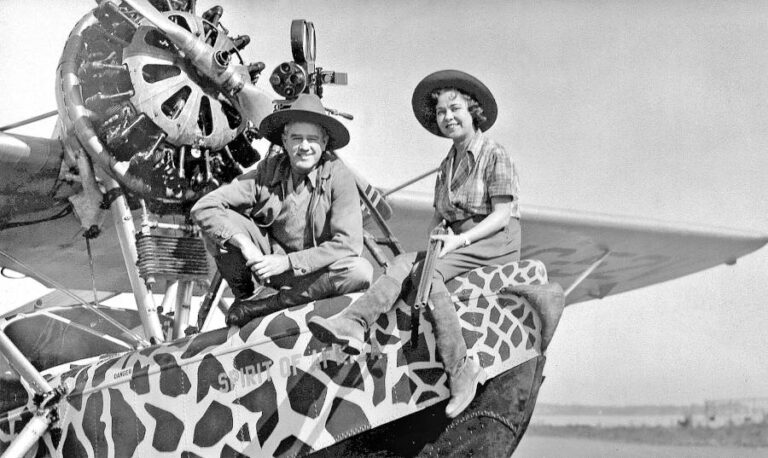
Martin and Osa Johnson. The FIRST motion picture explorers in history. In this photo, Martin and Osa film the Samburu warriors in northern Kenya, 1920s.
Martin and Osa Johnson were a swashbuckling husband-and-wife filmmaker team who “invented” the first non-hunting wildlife movie documentaries in history — long before Animal Planet.
PART ONE:
In a previous Elefence Blog post, we presented a video about Martin and Osa Johnson called “Wings Over Tanzania.”
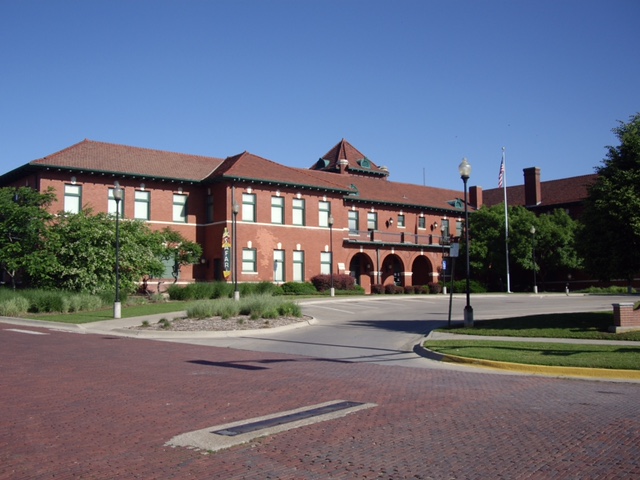
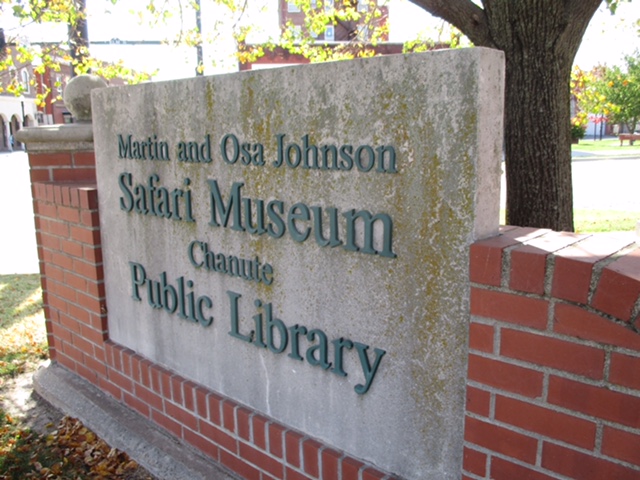
One of the most unique museums in the world preserves the lost wildlife and tribal worlds of the Johnsons: the MARTIN AND OSA JOHNSON SAFARI MUSEUM.
The Museum is based in Chanute, Kansas — OSA’s hometown.
The Museum’s Director, Conrad Froehlich, is an Honorary Trustee of Elefence International.
Note: parts two, three, and four will follow in subsequent posts.
The Martin and Osa Johnson Safari Museum is the epicenter of the motion picture history of pioneering African safaris, Borneo, and South Sea Island adventures in the early 1900s.
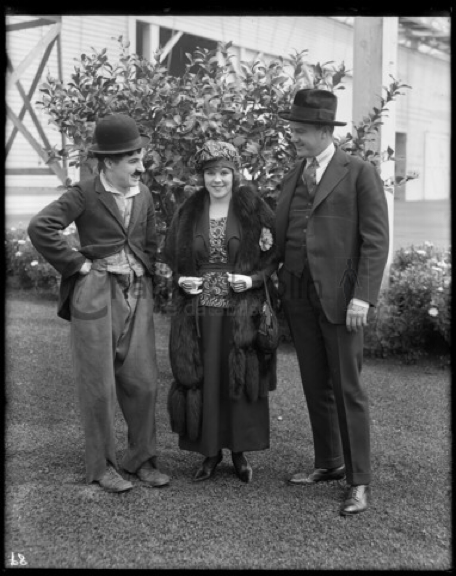
In the 1920s and 30s, Martin and Osa Johnson were household names as recognizable as Charlie Chaplin, Douglas Fairbanks, and Amelia Earhart.
The Johnsons pioneered flights over Africa — some 60,000 miles over the Dark Continent of unexplored jungles. They used two Sikorsky amphibious planes, necessary to land on rivers and lakes since there were still few wilderness airstrips in Africa in the early 1930s.
They barely survived some harrowing near-death-defying experiences in flight. At that time, there was no radar, no airfield radio communication in remote Africa locales — flying blindly into horrific rain storms with ZERO visibility. One can only imagine the terror — and the guts it took to do that. As a result, they preserved aerial images of once pristine landscapes that no longer exist.
No wonder their motion pictures were always box office hits on Broadway — and at hometown theaters across America and around the world. The Johnsons also pioneered the first all-talking sound motion pictures in Africa.
Please stay tuned for Parts two, three, and four in succeeding posts. We’ll tell the fascinating story of the Johnsons in a little more detail. And how their historic photographic record is preserved — including their one-of-a-kind original artifacts of exotic travels — at the award-winning Martin and Osa Johnson Safari Museum.
And learn how the facility is a living museum today for research — and creates awareness for preservation of endangered elephants and Africa’s shrinking wild places.
There are few places on earth where one can walk with wild elephants. Mana Pools in northern Zimbabwe is one such place.
When approaching elephant bulls while walking, it is important to remain downwind undetected (the elephant’s scent is blowing towards you) as most animals are instinctively fearful of man on foot.
Some bulls in Mana Pools can be extremely relaxed and accepting of humans. The trick is finding out which ones are ‘friendly’!
I was walking with some of my guests when I spotted this young elephant bull eating fallen pods from a winter thorn tree. This tree has extremely nutritious, protein-rich pods and are sought after by many animals in Mana, especially elephant.
We slowly approached to within a safe distance, where I purposely now allowed our scent to waft upwind toward the elephant! I didn’t want to surprise him. Elephants have an incredible sense of smell and could have picked up our scent from a huge distance away. I watched for his reaction. This is a simple way of gauging how receptive an elephant is to one’s presence.
It was at this time that I recognized the young bull as an elephant we called Toast — named after his habit of stealing toast off the camps’ breakfast tables! And I knew him well as a very calm bull.
I decided it was safe for us to edge ever closer to him. It was breathtaking as we stood under a tree and watched as he calmly walked around picking up the pods unperturbed by our presence.
As he ambled around the tree he slowly made his way towards us. This is when I placed myself in front of my guests. I then stood next to some of the delicious pods and knew he would soon approach, of which he did not disappoint!
Toast walked closer and closer and looked at me carefully, trying to ensure I was a friend and not a foe. After a few tense moments, he walked even closer till he stood right in front of me! Then he continued eating the pods.
He stood with me for some time investigating my scent with his trunk — and then suddenly turned and continued his search for more pods.
You can see why I love elephants. Their intelligence for sizing up a situation never ceases to amaze me.
Nic Polenakis Safari Guide and Elefence trustee
Elefence addendum: Nic is a certified professional guide who was named by National geographic as one of the top ten safari guides in Africa. He has the uncanny ability to read wildlife, especially elephants, which is how he is able to get so close as pictured above. He is not a hunter, but is required to carry a rifle in order to protect his clients in an emergency. Check his website http://www.myprivateafrica.com
At one time there was a theory put forth that elephants were telepathic. They seemed to be able control their actions when they could not see one another and neither did they make any noise. A herd would be spread out foraging when they would all stop and come together and move off in one direction. If there was a predator in the area they would gather and circle their babies to protect them. Well, we know now that they are not telepathic but they do communicate in ways we are only recently beginning to understand.
When Paula and I were on safari with Dick a few years ago, we were in a blind watching a small group of bulls at a water hole. We were within 15-20 feet of them which was exciting on its own but we could hear this low rumbling coming from different individuals. I asked our guide if that was their stomach growling and he replied “No, they are talking to one another”. I have learned since that elephant researchers have recorded these sounds and when played back they noted a reaction from specific individuals. They conclusion was that the sounds made related to a specific individual much like calling our someone’s name to a group.
Elephants are also known to communicate seismically – vibrations produced by impacts upon the earth. Foot stomping or false charges produce tremors which can be felt by other elephants up to 20 miles away.
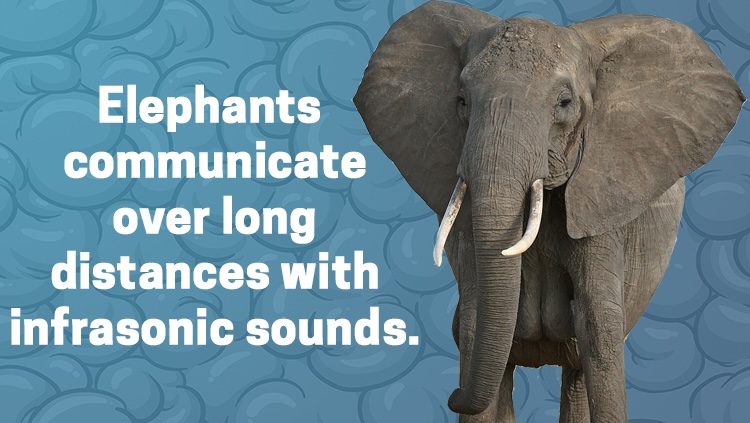
Surprisingly, elephants produce Ultra Low Frequency sounds that are below the range of human hearing. ULF sounds can travel long distances, up to 10 miles under the right conditions, both through the air as well as the ground. Other elephants can hear and interpret these sounds. Researchers have used special equipment to record these ULF sounds and have logged over 100 different sounds and combination of sounds made by elephants. We don’t know what they are saying yet, but there is no doubt that elephants do communicate.
I’m often asked what led me to go to Africa to operate safaris, and years later create Elefence International with its Founder, Bruce Lowe of Taft Law in Cleveland.
The story all started in an Ohio hometown theatre —which I wrote about decades later for a SMITHSONIAN magazine feature as follows in the intro…
“When I was a kid in Ashtabula, Ohio in the 1950s, Hollywood was churning out one African movie after another — everything from King Solomon’s Mines and The African Queen to Mogambo and The Roots of Heaven. My own favorite adventure films in those days were reruns of creaky documentaries about Africa that had been produced in the 1920s and 30s by Martin and Osa Johnson, a swashbuckling husband and wife team from Kansas. The Johnsons’ storylines were episodic, but their film formula was irresistible: mount an elaborate safari, improvise various situations as you go along and film them on the spot….”
Decades later the Martin and Osa Johnson Safari Museum in Kansas assigned me the task of finding and identifying the lost films of the Johnsons stored in an old vault at the Library of Congress.
The following video shows some of the lost footage now brought to light for the first time.
Part two by Dick Houston WHAT MAKES A GREAT SAFARI GUIDE?
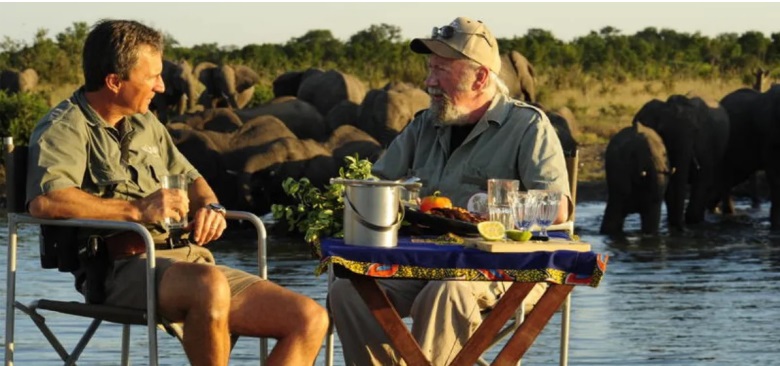
Nic Polenakis with friend Dick Houston of Elefence at a waterhole with unexpected thirsty guests. Hwange National Park, Zimbabwe
Part Two:
Later having sundowners by a waterhole in Hwange park, Nic and I start our stories regarding our separate experiences on operating safaris all over Africa. Nic has a quick wit and keen sense of humor, and we laugh a lot. We talk long into the night… Relaxed around safari fires with drink in hand, you can talk freely and be yourself. You really listen and get to know people. Nic is one of the most unassuming and honorable men I’ve ever known. Over the years I’ve seen he’s a devoted family man. I know his lovely wife Tracey and his animal-loving 13-year-old son Chris (who has an ever-grumbling Jack Russell named Grumpy, and a cool pet rooster named Mister Cheep Cheep!)
I ask Nic what first inspired him to live and work in the bush — and what he had to do to make his dream come true as a non-hunting safari guide. Nic thinks a moment and then tells his story to me… “You know, Dick, being trained as a professional guide in Zimbabwe, where I was born, is extremely arduous. And is arguably Africa’s toughest and most rigorous professional guides examination process.
I served my 3 year apprentice on a rhino conservancy under a fully qualified professional guide where I mastered the basics of bush lore, tree identification, animal behavior, mammals, birds, arthropods, star gazing, general knowledge, shooting, safety, advanced first aid, spoor and skull identification, mechanics and much more.
During this learning period I had many exciting forays. I lay in ambush against poachers, climbed trees to escape black rhino, was charged by elephant, stood face to face with 3 black mambas! Then, of all things, I had a close shave with a domestic Brahman Bull! Yes you heard right! I will never forget being told to go and destroy a Brahman bull that escaped its pen, and was running wild and could not be captured.
I couldn’t believe this easy task; I mean if it was a Cape buffalo it would be one thing but a domestic bull?! This was surely no challenge at all…
I finally located the ‘’wild animal’’ and after setting up an ambush I stood on a path and waited for it to approach. The huge Brahman bull ambled towards me, raised his head and charged! I was taken totally by surprise and raised my rifle and fired in time, dropping him only feet from me! This was nearly an embarrassing situation, one in which I don’t think my fellow colleagues would have let me off so lightly!
After passing the stringent professional guides written exam, I was invited to the shooting practical exam where shooting both moving and fixed targets set at varying distances, where speed, accuracy, weapon handling and safety were paramount. This is a crucial aptitude when you are responsible for the safety of your clients on walking safaris into the bush.
Years earlier and after making my mind up that I was going to be a professional guide, I purchased a .458 Winchester mag and took it to the range to try it out. Sitting on the ground I raised my rifle, took aim at the target and slowly squeezed the trigger. After the dust had settled and my ears normalized, I sat there in total disbelief and shock!! My shoulder felt like it was broken, and I think I missed the target all together! What came to my mind was how on earth was I to one day become proficient at shooting this thing?
After passing the shooting exam, I was invited to the next step: a daunting oral interview where one sits in front of his peers and is bombarded with questions. This is then followed by the dreaded ‘nature table’ where one has to identify skulls, tree pods, arthropods, bird feathers, nests and seemingly endless ‘artifacts’. Only candidates whom the panel deem competent, and ready for the last hurdle, are invited to the final practical exam.
This one-week-long practical exam is legendary, and not for the faint-hearted. Here, a total of 20 plus aspiring professional guides, are broken into groups of 4 to 5 hopefuls. They are expected to set up their tented camp and host some of the examiners. There is no place to hide and you are expected to excel. It is grueling, tiresome and nerve-racking where one is examined on everything and anything!
When I took the learner’s examination there were over 200 candidates. By the time the practical exam arrived 3 years later, there were about 20 of us left — of which only 4 passed. I was one of them.…”
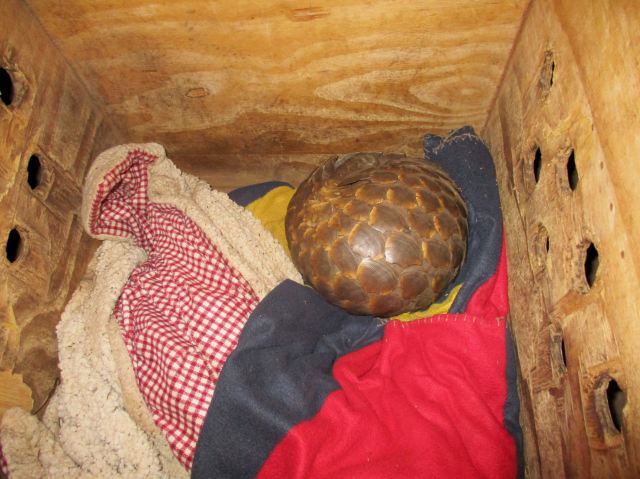
Pangolins, or scaly anteaters as they are often called, are one of nature’s oddest creatures. They have a small compact body covered with scales made of keratin which is the same material as our human fingernails. Pangolins are found in Asia and sub-Saharan Africa. They feed exclusively on ants and termites and roll up in a ball to protect themselves if they are threatened by a predator.
Pangolins are the most trafficked wild animals in the world, and are endangered due to poaching. Deforestation has also impacted their numbers. They are sold mainly into China where their scales and meat are touted to be a cure for everything from arthritis to warts. Their meat is consumed and the scales ground into a powder both of which bring very high prices on the black market.
When captured pangolins are intercepted by rangers and customs officials the pangolins are often undernourished and in poor condition due to injuries, With these problems they cannot be returned to the wild as they would not survive. Enter Elefence’s partner in Malawi, Wildlife Action Group which is an authorized pangolin rehab center. Any wounds are treated but the problem is how to feed them. Purina does not make pangolin chow.
The solution to getting them food is to take them into the bush and find rotten logs filled with ants and termite mounds. Dick and I were fortunate to go on one of the feeding sessions. A ranger put a blanket over his shoulder and draped the pangolin on it. In addition to the keeper there was a ranger who kept track of the pangolin feeding and another ranger to watch for elephants or Cape buffalos — two of the most dangerous animals in Thuma, especially when surprised on a forest trail. The rangers locate a rotten stump and set the pangolin in front of it. The pangolin immediately knew what to do and tore into the stump with their powerful front feet and long claws. They used their long sticky tongue to gather the insects and quickly bring them into their snout. After several feeding sessions the animal was returned to the WAG office where it would curl up and sleep off its meal. Elefence is proud to be a partner and supporter of WAG in their efforts to protect the two forest reserves and the animals which live in it.
One of the trail cameras at Thuma Forest Reserve in Malawi caught a tragic incident. A matriarch of an elephant herd had been killed for her tusks. In the video link below you will see the reaction of her loyal herd. Despite this tragedy, there’s good news. Elefence recently funded the completion of the solar electric fence surrounding Thuma Forest. The purpose is twofold: safeguard the people from crop raiding elephants: and safeguard the elephants from ivory poachers. Today, there is ZERO poaching of elephants at Thuma Forest. And Zero human-elephant conflict of the surrounding villages of Thuma. The video is only 2 1/2 minutes long but contains a powerful message.











 Elefence International, Inc.