One of the Most Dangerous Jobs in the World!

By Dick Houston

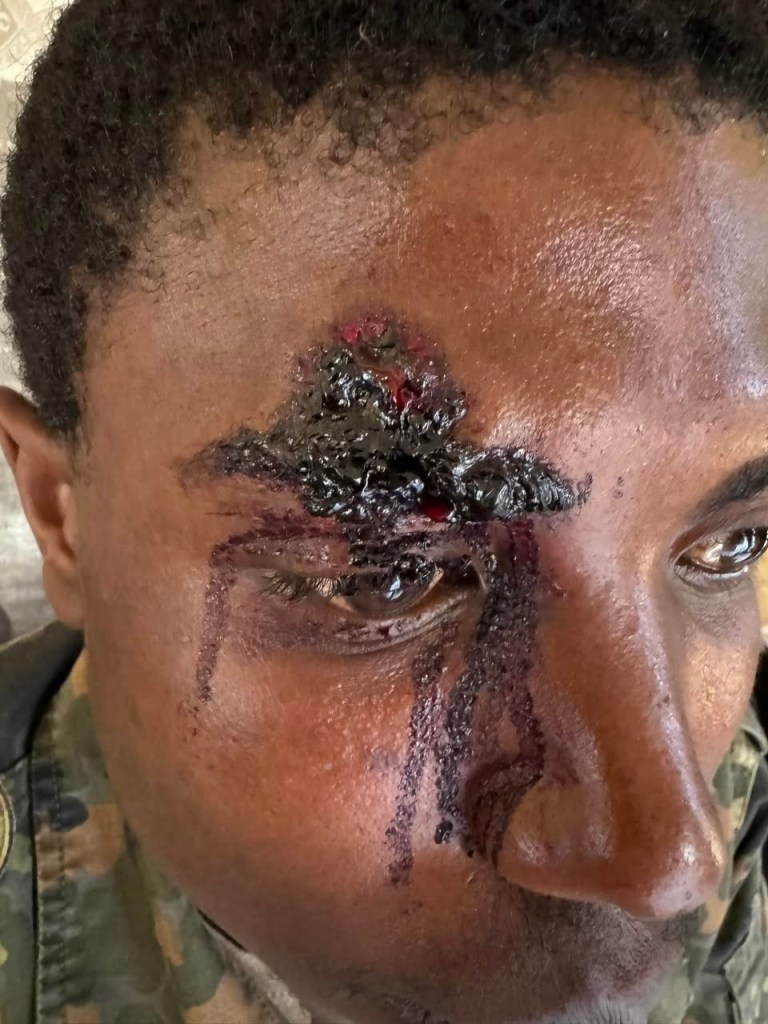
A wounded ranger is pictured after a recent encounter with a gang of poachers. Fortunately it was only a flesh wound. But a WAG ranger was killed by a poacher a few years ago and another ranger was recently killed by an elephant while a third was gored by a cape buffalo. A forest ranger’s job is one of the most dangerous in the world. About 150 rangers worldwide die each year protecting wildlife according to the Thin Green Line (TGL) Foundation, an international charity.

Conflicts with poachers are responsible for 50 to 70% of ranger deaths on the job, according to data from TGL. The rest are attributed to daily challenges such as hazardous environments and dangerous animals – especially elephants and Cape buffalos.

Africa is know for its vast nature reserves, ecotourism and educational approach to conservation. Unfortunately, armed poachers and militant gangs are targeting African rangers. In Africa, an astounding 82% of rangers said they have faced a life-threatening situation in the line of duty.

WOULD YOU TAKE ON THIS JOB FOR $3 A DAY? This is why Elefence, in partnership with Malawi’s Wildlife Action Group (WAG), works to find financial support for the 51-man strong team of rangers. Elefence and WAG initiated a Ranger Cash Reward Program for various rangers who’ve shown meritorious work in the field protecting elephants and other highly endangered wild animals.

Keep in mind, these men struggle to feed their families while they are on patrol in the forest 25 days a month living in primitive conditions with no access to emergency medical care. If badly wounded in the field their chances of survival are slim. There are no medics on the patrol teams. ( Our pioneer Elefence trustee, Max Seymour, was a battlefield medic in Viet Nam, and knows well how crucial immediate emergency care is in the field.) {see Elefence team bios on our website, http://www.elefence.org.}

Elefence has just given the 51 rangers Christmas bonuses of $10 each. It is humbling and emotionally gripping to see these men so thrilled to receive such a modest amount. We wish it could be more , but we can only give what is contributed since Elefence and WAG are small organizations, continually and frustratingly, challenged to find funding. Sad that in a world run by billionaires these brave rangers who work to save fragile ecosystems and wildlife for the world’s future, scramble for crumbs.

Without funding, the rangers of Thuma and Dedza-Salima forest reserves will not be able to continue their work. If you are interested in helping these brave men, please contact us directly or make a contribution directly on the Elefence website. If you have donated recently we thank you -and be assured that donations go directly to our efforts in Malawi. Elefence International Inc. is a USA registered 501(c)3 charity and all contributions are tax-exempt.

Please remember to frequently check our blog for more stories about the rangers and their ongoing work to protect the forest and its wildlife

Merry Christmas everyone from ELEFENCE and WAG. Thank you for reading.
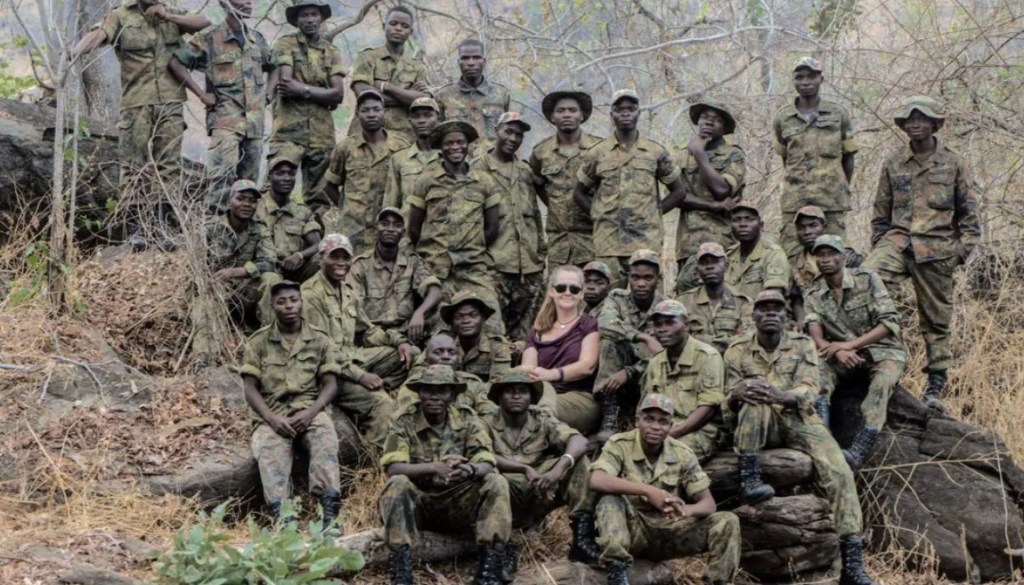
Lynn Clifford, WAG Field Officer Of Thuma and Dezdza-Salima Forest Reserves, is seen surrounded by her brave anti-poaching rangers who have recently expanded to 51 members. Thanks to Lynn and her team the Thuma Forest Reserve is now the most protected forest in Malawi. Work continues in the Dedza-Salima Reserve.

TOAST

By Nic Polenakis

There are few places on earth where one can walk with wild elephants. Mana Pools in northern Zimbabwe is one such place.
 
When approaching elephant bulls while walking, it is important to remain downwind undetected (the elephant’s scent is blowing towards you) as most animals are instinctively fearful of man on foot.

Some bulls in Mana Pools can be extremely relaxed and accepting of humans. The trick is finding out which ones are ‘friendly’!

I was walking with some of my guests when I spotted this young elephant bull eating fallen pods from a winter thorn tree. This tree has extremely nutritious, protein-rich pods and are sought after by many animals in Mana, especially elephant. 

We slowly approached to within a safe distance, where I purposely now allowed our scent to waft upwind toward the elephant! I didn’t want to surprise him. Elephants have an incredible sense of smell and could have picked up our scent from a huge distance away. I watched for his reaction. This is a simple way of gauging how receptive an elephant is to one’s presence.

It was at this time that I recognized the young bull as an elephant we called Toast — named after his habit of stealing toast off the camps’ breakfast tables! And I knew him well as a very calm bull.

I decided it was safe for us to edge ever closer to him. It was breathtaking as we stood under a tree and watched as he calmly walked around picking up the pods unperturbed by our presence.

As he ambled around the tree he slowly made his way towards us. This is when I placed myself in front of my guests. I then stood next to some of the delicious pods and knew he would soon approach, of which he did not disappoint!

Toast walked closer and closer and looked at me carefully, trying to ensure I was a friend and not a foe. After a few tense moments, he walked even closer till he stood right in front of me! Then he continued eating the pods.

He stood with me for some time investigating my scent with his trunk — and then suddenly turned and continued his search for more pods.

You can see why I love elephants. Their intelligence for sizing up a situation never ceases to amaze me.

Nic Polenakis
Safari Guide and Elefence trustee

Elefence addendum: Nic is a certified professional guide who was named by National geographic as one of the top ten safari guides in Africa. He has the uncanny ability to read wildlife, especially elephants, which is how he is able to get so close as pictured above. He is not a hunter, but is required to carry a rifle in order to protect his clients in an emergency. Check his website http://www.myprivateafrica.com

What Makes A Great Bush Guide

Part two by Dick Houston
WHAT MAKES A GREAT SAFARI GUIDE?


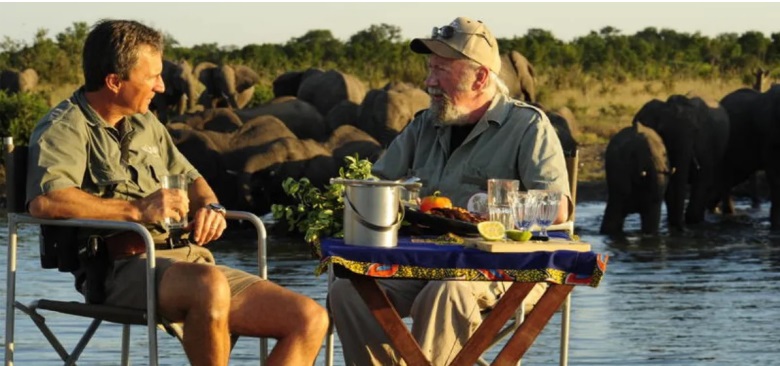
Nic Polenakis with friend Dick Houston of Elefence at a waterhole
with unexpected thirsty guests. Hwange National Park,
Zimbabwe


Part Two:


Later having sundowners by a waterhole in Hwange park, Nic and
I start our stories regarding our separate experiences on
operating safaris all over Africa. Nic has a quick wit and keen
sense of humor, and we laugh a lot. We talk long into the night…
Relaxed around safari fires with drink in hand, you can talk freely
and be yourself. You really listen and get to know people. Nic is
one of the most unassuming and honorable men I’ve ever known.
Over the years I’ve seen he’s a devoted family man. I know his
lovely wife Tracey and his animal-loving 13-year-old son Chris
(who has an ever-grumbling Jack Russell named Grumpy, and a
cool pet rooster named Mister Cheep Cheep!)


I ask Nic what first inspired him to live and work in the bush — and
what he had to do to make his dream come true as a non-hunting
safari guide. Nic thinks a moment and then tells his story to me…
“You know, Dick, being trained as a professional guide in
Zimbabwe, where I was born, is extremely arduous. And is
arguably Africa’s toughest and most rigorous professional guides
examination process.


I served my 3 year apprentice on a rhino conservancy under a
fully qualified professional guide where I mastered the basics of
bush lore, tree identification, animal behavior, mammals, birds,
arthropods, star gazing, general knowledge, shooting, safety,
advanced first aid, spoor and skull identification, mechanics and
much more.


During this learning period I had many exciting forays. I lay in
ambush against poachers, climbed trees to escape black rhino,
was charged by elephant, stood face to face with 3 black
mambas! Then, of all things, I had a close shave with a domestic
Brahman Bull! Yes you heard right! I will never forget being told to
go and destroy a Brahman bull that escaped its pen, and was
running wild and could not be captured.


I couldn’t believe this easy task; I mean if it was a Cape buffalo it
would be one thing but a domestic bull?! This was surely no
challenge at all…


I finally located the ‘’wild animal’’ and after setting up an ambush I
stood on a path and waited for it to approach. The huge Brahman
bull ambled towards me, raised his head and charged! I was
taken totally by surprise and raised my rifle and fired in time,
dropping him only feet from me! This was nearly an embarrassing
situation, one in which I don’t think my fellow colleagues would
have let me off so lightly!


After passing the stringent professional guides written exam, I
was invited to the shooting practical exam where shooting both
moving and fixed targets set at varying distances, where speed,
accuracy, weapon handling and safety were paramount. This is a
crucial aptitude when you are responsible for the safety of your
clients on walking safaris into the bush.


Years earlier and after making my mind up that I was going to be
a professional guide, I purchased a .458 Winchester mag and
took it to the range to try it out. Sitting on the ground I raised my
rifle, took aim at the target and slowly squeezed the trigger. After
the dust had settled and my ears normalized, I sat there in total
disbelief and shock!! My shoulder felt like it was broken, and I
think I missed the target all together! What came to my mind was
how on earth was I to one day become proficient at shooting this
thing?


After passing the shooting exam, I was invited to the next step: a
daunting oral interview where one sits in front of his peers and is
bombarded with questions. This is then followed by the dreaded
‘nature table’ where one has to identify skulls, tree pods,
arthropods, bird feathers, nests and seemingly endless ‘artifacts’.
Only candidates whom the panel deem competent, and ready for
the last hurdle, are invited to the final practical exam.


This one-week-long practical exam is legendary, and not for the
faint-hearted. Here, a total of 20 plus aspiring professional guides,
are broken into groups of 4 to 5 hopefuls. They are expected to
set up their tented camp and host some of the examiners. There
is no place to hide and you are expected to excel. It is grueling,
tiresome and nerve-racking where one is examined on everything
and anything!


When I took the learner’s examination there were over 200
candidates. By the time the practical exam arrived 3 years later,
there were about 20 of us left — of which only 4 passed. I was one
of them.…”