Nic is an Elefence trustee and a premier safari guide in Africa. This is just one of his stories.
To Dick Houston
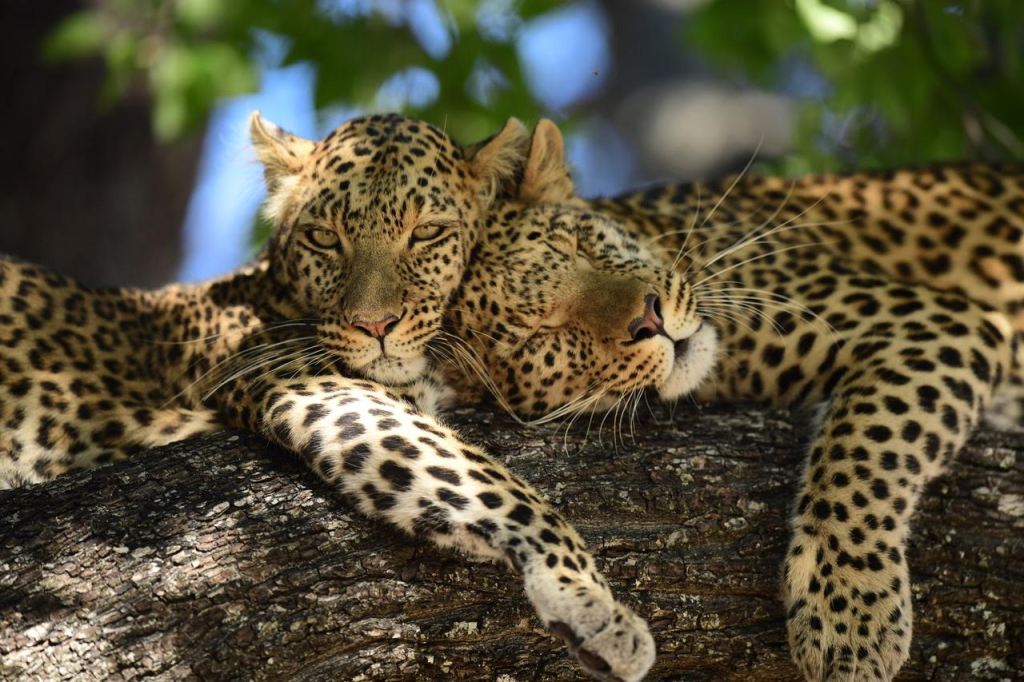
I have included one of my personal favourite photographs (And experiences) from the season. This female leopard, on the left, had just killed an impala, and instead of feeding, she hid the prey, then immediately went off in search of her two year old son who she had not seen in days. As soon as she was in the vicinity where she last saw him she began to call. At first her calls were soft, so as to not attract unwanted attention, the intervals long. She stopped, listened for an answer and then continued to weave in and out of the thick terrain. The tension was palpable, she had to find him, instinct drove her. As time slipped away her calls became more desperate, more frequent, louder and then she froze! Her ears picked up, her face changed, we knew she had heard a response even though we didn’t hear a thing. She sat down and then out of the thickets a young beautiful male leopard bounded out to greet his mom. Affectionately rubbing his head against hers, jumping all over her, rolling on the ground and then repeating the sequence over and over again. She then expertly climbed a tree and her son soon followed, lying next to her he licked her face, excitedly anticipating her next move. It wasn’t long before she led him back to the unfortunate impala who was to provide life to the next generation of big cats.
Nic, operates a safari company which has been recognized as one of the best in Africa.
Read more about Nic by scrolling down to our previous posts Introducing Nic Polenakis and What Makes a great bush Guide. We are fortunate to have Nic as one of our trustees. You can see more of his operation on his website myprivateafrica.com.
Stay turned for a major announcement coming soon about our next project.
Part two by Dick Houston WHAT MAKES A GREAT SAFARI GUIDE?
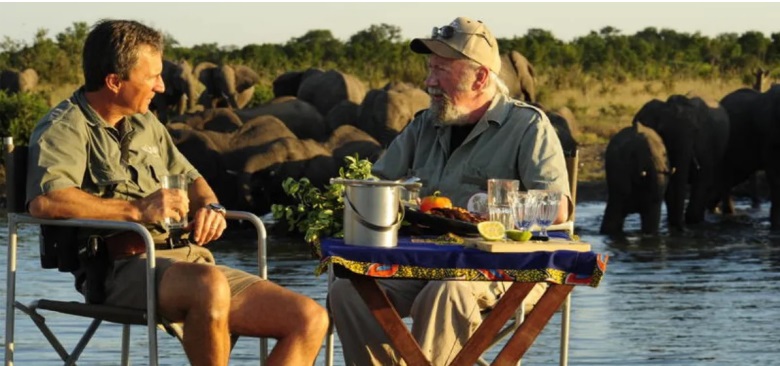
Nic Polenakis with friend Dick Houston of Elefence at a waterhole with unexpected thirsty guests. Hwange National Park, Zimbabwe
Part Two:
Later having sundowners by a waterhole in Hwange park, Nic and I start our stories regarding our separate experiences on operating safaris all over Africa. Nic has a quick wit and keen sense of humor, and we laugh a lot. We talk long into the night… Relaxed around safari fires with drink in hand, you can talk freely and be yourself. You really listen and get to know people. Nic is one of the most unassuming and honorable men I’ve ever known. Over the years I’ve seen he’s a devoted family man. I know his lovely wife Tracey and his animal-loving 13-year-old son Chris (who has an ever-grumbling Jack Russell named Grumpy, and a cool pet rooster named Mister Cheep Cheep!)
I ask Nic what first inspired him to live and work in the bush — and what he had to do to make his dream come true as a non-hunting safari guide. Nic thinks a moment and then tells his story to me… “You know, Dick, being trained as a professional guide in Zimbabwe, where I was born, is extremely arduous. And is arguably Africa’s toughest and most rigorous professional guides examination process.
I served my 3 year apprentice on a rhino conservancy under a fully qualified professional guide where I mastered the basics of bush lore, tree identification, animal behavior, mammals, birds, arthropods, star gazing, general knowledge, shooting, safety, advanced first aid, spoor and skull identification, mechanics and much more.
During this learning period I had many exciting forays. I lay in ambush against poachers, climbed trees to escape black rhino, was charged by elephant, stood face to face with 3 black mambas! Then, of all things, I had a close shave with a domestic Brahman Bull! Yes you heard right! I will never forget being told to go and destroy a Brahman bull that escaped its pen, and was running wild and could not be captured.
I couldn’t believe this easy task; I mean if it was a Cape buffalo it would be one thing but a domestic bull?! This was surely no challenge at all…
I finally located the ‘’wild animal’’ and after setting up an ambush I stood on a path and waited for it to approach. The huge Brahman bull ambled towards me, raised his head and charged! I was taken totally by surprise and raised my rifle and fired in time, dropping him only feet from me! This was nearly an embarrassing situation, one in which I don’t think my fellow colleagues would have let me off so lightly!
After passing the stringent professional guides written exam, I was invited to the shooting practical exam where shooting both moving and fixed targets set at varying distances, where speed, accuracy, weapon handling and safety were paramount. This is a crucial aptitude when you are responsible for the safety of your clients on walking safaris into the bush.
Years earlier and after making my mind up that I was going to be a professional guide, I purchased a .458 Winchester mag and took it to the range to try it out. Sitting on the ground I raised my rifle, took aim at the target and slowly squeezed the trigger. After the dust had settled and my ears normalized, I sat there in total disbelief and shock!! My shoulder felt like it was broken, and I think I missed the target all together! What came to my mind was how on earth was I to one day become proficient at shooting this thing?
After passing the shooting exam, I was invited to the next step: a daunting oral interview where one sits in front of his peers and is bombarded with questions. This is then followed by the dreaded ‘nature table’ where one has to identify skulls, tree pods, arthropods, bird feathers, nests and seemingly endless ‘artifacts’. Only candidates whom the panel deem competent, and ready for the last hurdle, are invited to the final practical exam.
This one-week-long practical exam is legendary, and not for the faint-hearted. Here, a total of 20 plus aspiring professional guides, are broken into groups of 4 to 5 hopefuls. They are expected to set up their tented camp and host some of the examiners. There is no place to hide and you are expected to excel. It is grueling, tiresome and nerve-racking where one is examined on everything and anything!
When I took the learner’s examination there were over 200 candidates. By the time the practical exam arrived 3 years later, there were about 20 of us left — of which only 4 passed. I was one of them.…”



 Elefence International, Inc.