

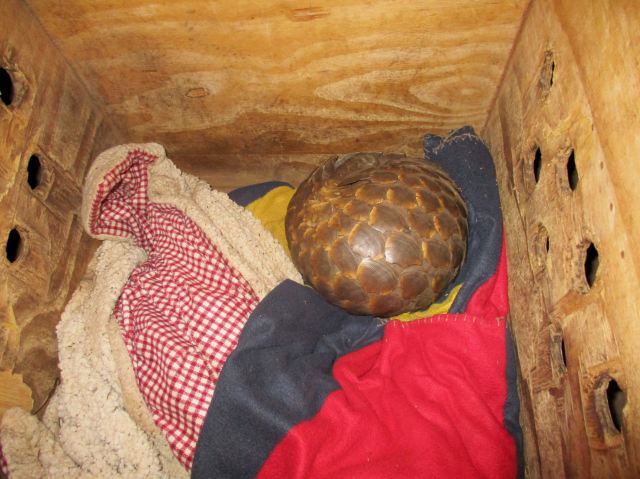
Pangolins, or scaly anteaters as they are often called, are one of nature’s oddest creatures. They have a small compact body covered with scales made of keratin which is the same material as our human fingernails. Pangolins are found in Asia and sub-Saharan Africa. They feed exclusively on ants and termites and roll up in a ball to protect themselves if they are threatened by a predator.

Pangolins are the most trafficked wild animals in the world, and are endangered due to poaching. Deforestation has also impacted their numbers. They are sold mainly into China where their scales and meat are touted to be a cure for everything from arthritis to warts. Their meat is consumed and the scales ground into a powder both of which bring very high prices on the black market.
When captured pangolins are intercepted by rangers and customs officials the pangolins are often undernourished and in poor condition due to injuries, With these problems they cannot be returned to the wild as they would not survive. Enter Elefence’s partner in Malawi, Wildlife Action Group which is an authorized pangolin rehab center. Any wounds are treated but the problem is how to feed them. Purina does not make pangolin chow.
The solution to getting them food is to take them into the bush and find rotten logs filled with ants and termite mounds. Dick and I were fortunate to go on one of the feeding sessions. A ranger put a blanket over his shoulder and draped the pangolin on it. In addition to the keeper there was a ranger who kept track of the pangolin feeding and another ranger to watch for elephants or Cape buffalos — two of the most dangerous animals in Thuma, especially when surprised on a forest trail. The rangers locate a rotten stump and set the pangolin in front of it. The pangolin immediately knew what to do and tore into the stump with their powerful front feet and long claws. They used their long sticky tongue to gather the insects and quickly bring them into their snout. After several feeding sessions the animal was returned to the WAG office where it would curl up and sleep off its meal. Elefence is proud to be a partner and supporter of WAG in their efforts to protect the two forest reserves and the animals which live in it.


 Elefence International, Inc.
These are really beautiful
LikeLike
Gentle creature who want nothing more to be left alone.
LikeLike
Really enjoyed this artic
LikeLike