Nic is an Elefence trustee and a premier safari guide in Africa. This is just one of his stories.
To Dick Houston
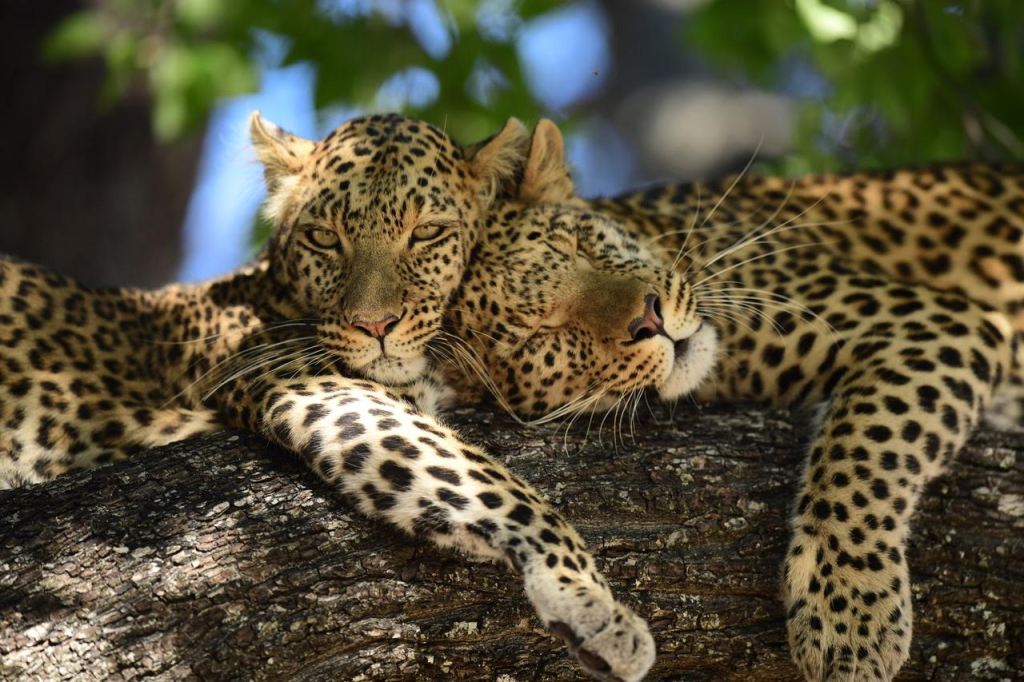
I have included one of my personal favourite photographs (And experiences) from the season. This female leopard, on the left, had just killed an impala, and instead of feeding, she hid the prey, then immediately went off in search of her two year old son who she had not seen in days. As soon as she was in the vicinity where she last saw him she began to call. At first her calls were soft, so as to not attract unwanted attention, the intervals long. She stopped, listened for an answer and then continued to weave in and out of the thick terrain. The tension was palpable, she had to find him, instinct drove her. As time slipped away her calls became more desperate, more frequent, louder and then she froze! Her ears picked up, her face changed, we knew she had heard a response even though we didn’t hear a thing. She sat down and then out of the thickets a young beautiful male leopard bounded out to greet his mom. Affectionately rubbing his head against hers, jumping all over her, rolling on the ground and then repeating the sequence over and over again. She then expertly climbed a tree and her son soon followed, lying next to her he licked her face, excitedly anticipating her next move. It wasn’t long before she led him back to the unfortunate impala who was to provide life to the next generation of big cats.
Nic, operates a safari company which has been recognized as one of the best in Africa.
Read more about Nic by scrolling down to our previous posts Introducing Nic Polenakis and What Makes a great bush Guide. We are fortunate to have Nic as one of our trustees. You can see more of his operation on his website myprivateafrica.com.
Stay turned for a major announcement coming soon about our next project.
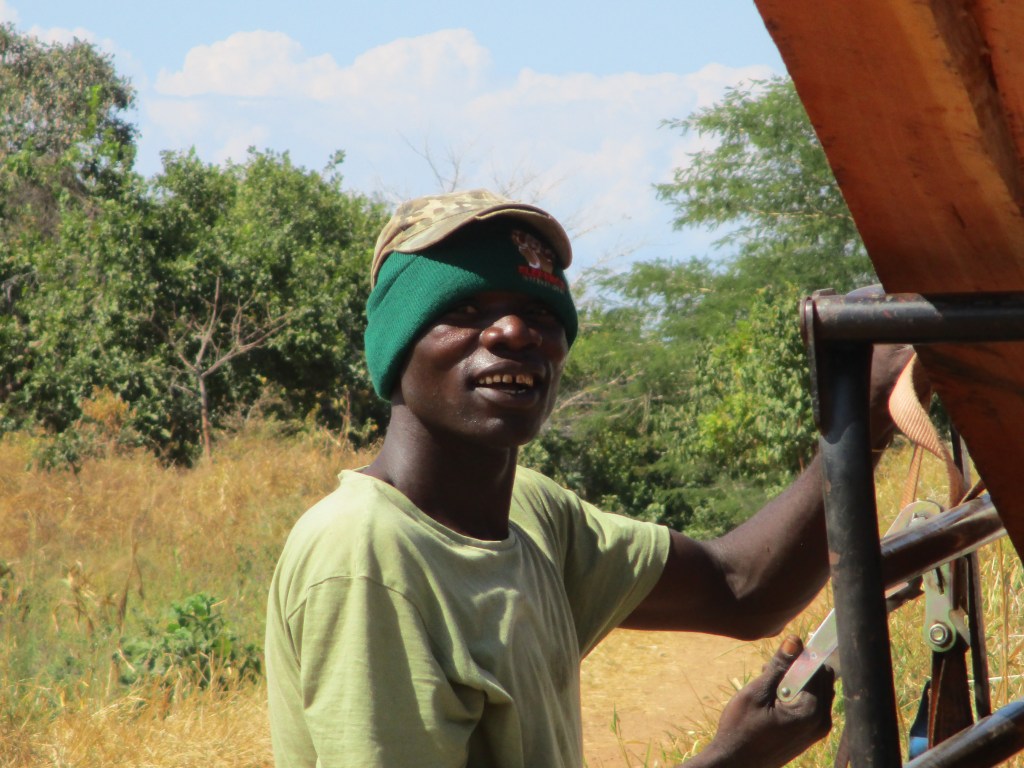
For our trip we wanted to take something for the WAG rangers. In communicating with Lynn she suggested we bring some ‘beanies’ or what we call stocking caps. Winter in Malawi can get cold, especially at night when the rangers are on patrol or stationed at one of the satellite camps throughout the forests. We contacted a local company to produce these with the Elefence logo on them. A couple of our loyal supporters stepped up to fund the purchase. We passed them out to as many of the rangers we encountered and left the balance from the original 50 with WAG. The rangers seemed to appreciate them and some even wore the on a couple of warm days.
On our second day in camp we went on a pangolin feeding bush walk with the rangers. A description of our walk is in an earlier post in the blog. While we were on the walk a radio call came in telling us to come back to camp because MR. M was coming. We did not know who he was but figured he must be someone of importance. We jumped into the Land Cruiser and bumped our way back to camp where we discovered MR. M was an elephant, so named because he had what looked like a M on one ear. I could not see it. The video below was shot from my hut. I remembered that I had heard something big outside my hut in the middle of the night but I elected not to go out and check. Of course my grass hut would not offer much protection as an elephant could walk through it without any trouble.
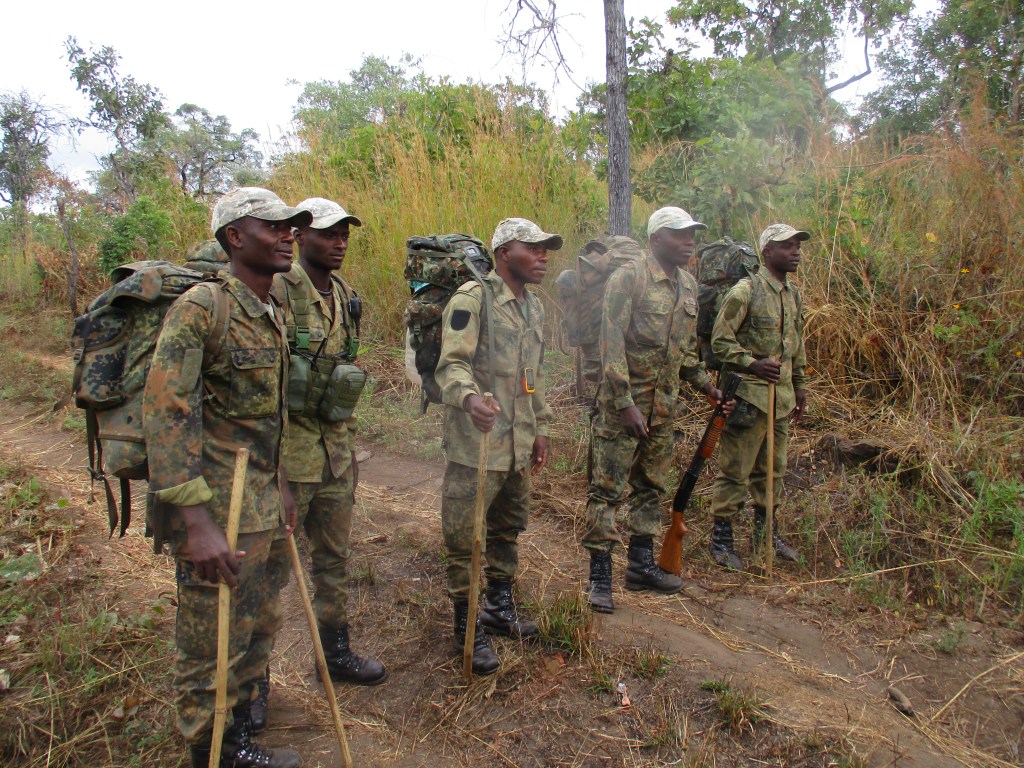
One afternoon while we were in camp a tip came in that a poacher was operating in Thuma forest. A team of rangers were called up to investigate. They suited up and we ferried them out into the area where he was reported to be operating. The rangers carried large packs and they were to spend three days in the forest patrolling and watching for the poacher. They caught him on the second night and he was brought in for trial. Unfortunately he had already killed a warthog but he will be going to prison for a long time as Malawi courts hand down some severe penalties for poaching.
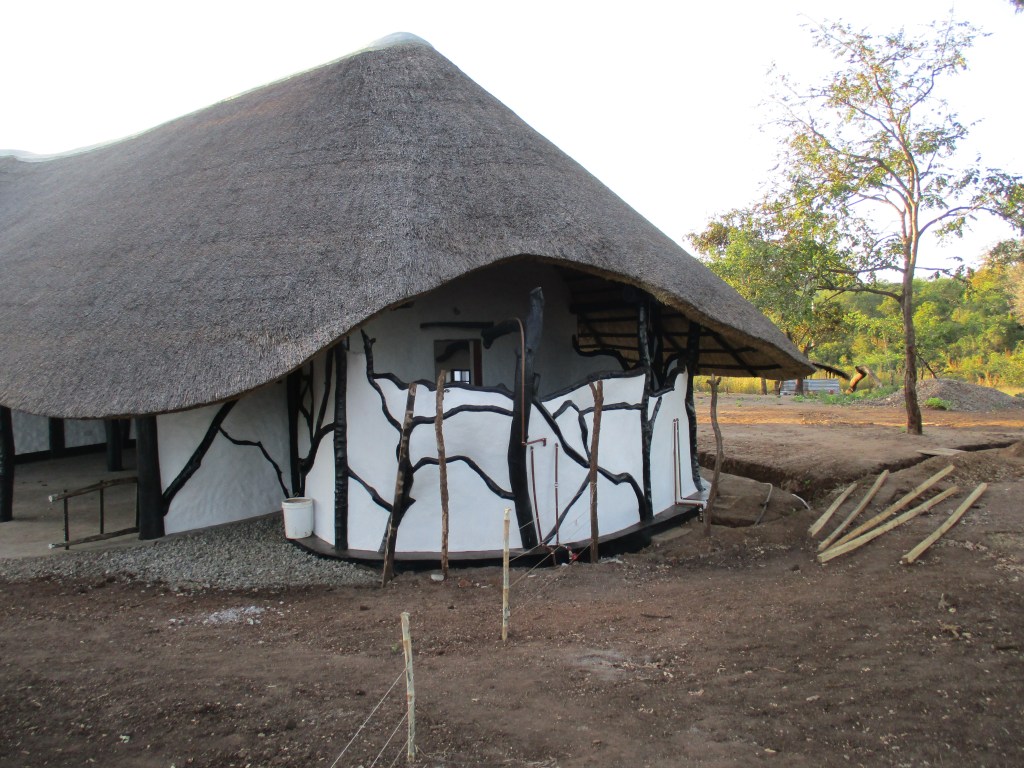
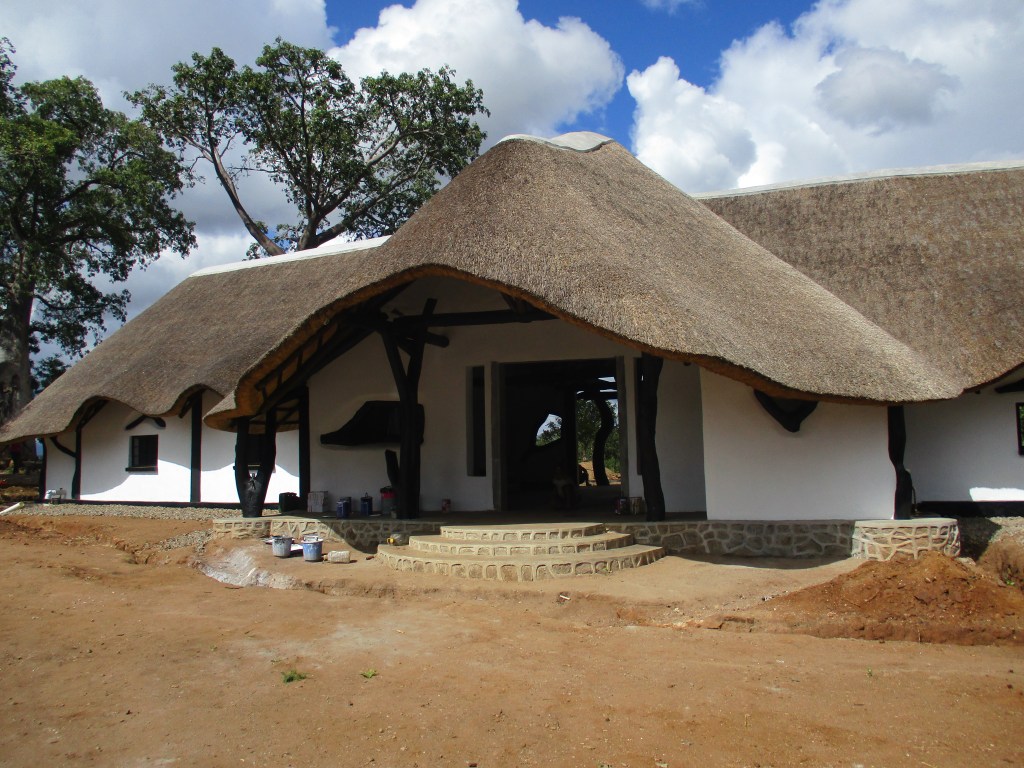
We made several trips to the lodge being built to attract tourists to Malawi. Lynn is directly supervising the design construction and it will be beautiful when complete.
We went to one of the ranger satellite camps in the forest and spent a night. These camps are even more spartan than the base camp but it gave us more appreciation for the dedication of the rangers.
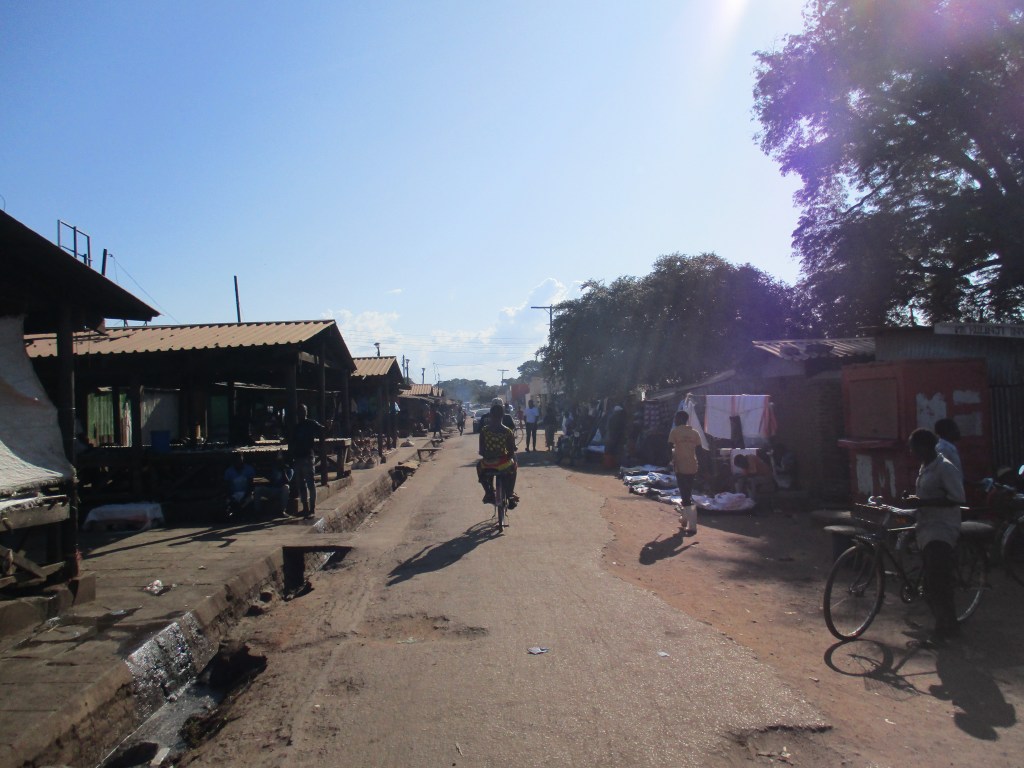
We went to the local market in Salima. It looked like there was a great deal of produce available but Lynn reminded us that this was right after harvest so things looks pretty good. Unfortunately there is little in the way of preservation so what is not consumed quickly will go to waste.
We left Malawi with a much better appreciation for the work being done by WAG. The crushing poverty we saw was depressing but it was offset by the spirit of the Malawi people. For much of the time Dick, Lynn and myself were the only white people we saw but I never felt any animosity from the locals. As we rode along through the villages the people would wave and the children would run out to the road and jump and clap. Malawi is called the “Warm Heart of Africa” and I can see why.
Our trip to Malawi had several goals. First was to meet Lynn Clifford, Field Operations Manager of Wildlife Action Group (WAG) for the Thuma and Dedza-Salima Forest reserves. We had corresponded with Lynn over two years but not able to travel due to the Covid restrictions.
Lynn Clifford
Second was to review the fence we funded, thanks to a generous donor, which was the last section to encircle the Thuma forest. It is always our policy to make sure the money we send is actually being used as intended. Since the completion of the fence there has been zero human elephant conflict around Thuma much to the delight of the villages in the area. Their crops are now safe from marauding wildlife. It only takes one or two elephants to wipe out and entire harvest and leave a family fighting for survival. Raids by wildlife usually calls for killing the animals.
Solar power supply for the Elefence fence.
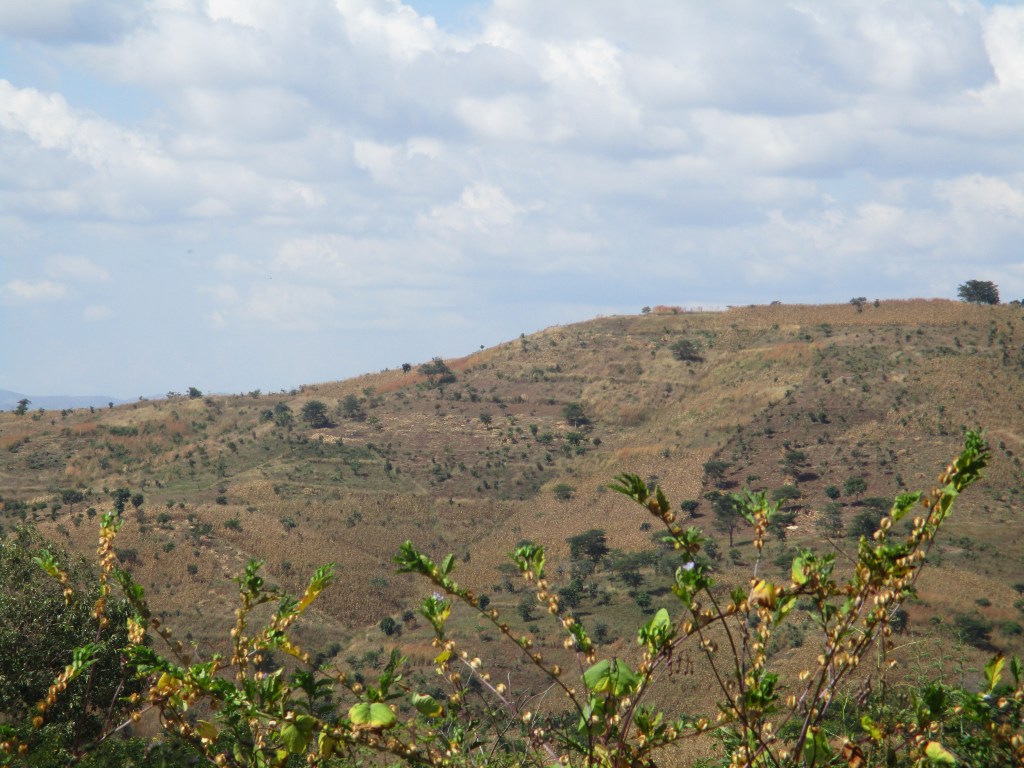
A fence also defines a clear boundary around the forest. Persons inside the fence without a permit to harvest bamboo for construction or to gather dead wood were usually doing something illegal such as poaching wildlife or cutting trees for charcoal production. The pictures below were taken of the same hillside inside the fence over three years. The first one shows the land almost completely denuded of vegetation. The second shows how the forest can recover if given the opportunity to regenerate.
Thirdly we wanted to review all the various community and ecological programs established by WAG to see where else we could help. Our primary mission is building solar powered electric fences but it is not possible to build a fence without the cooperation of the local villages surrounding the forest. The villages have had access to the forest for generations and you cannot take that way without providing them with alternatives. We toured the area with Austin Chimbalanga, the WAG Community Outreach Officer.
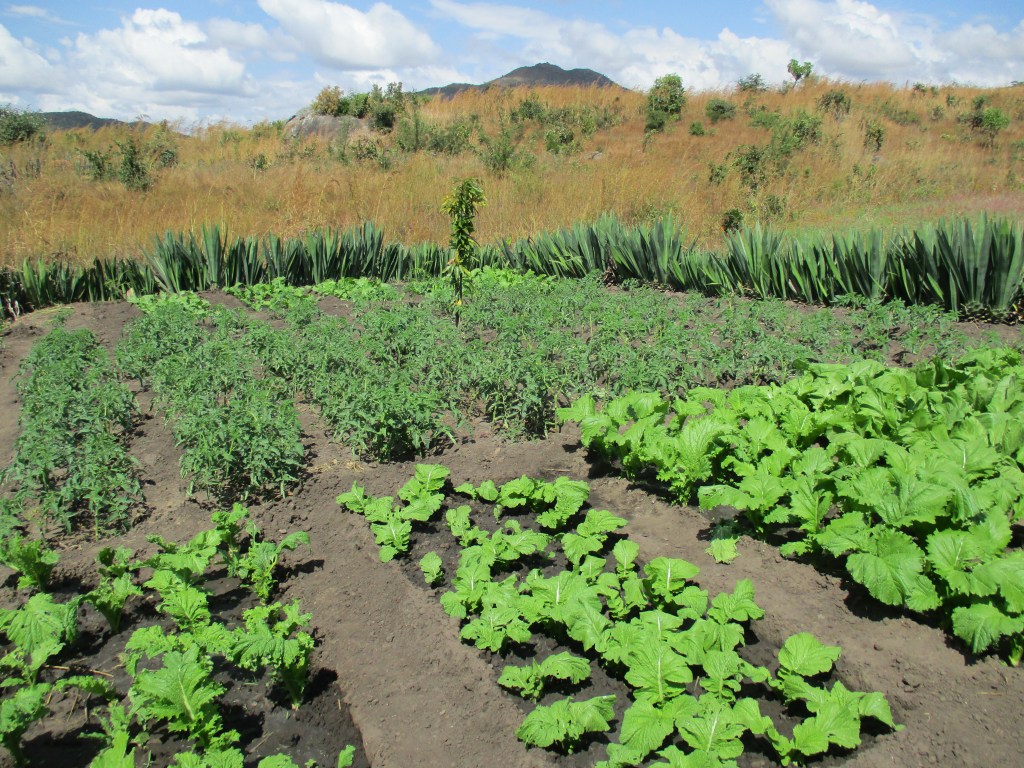
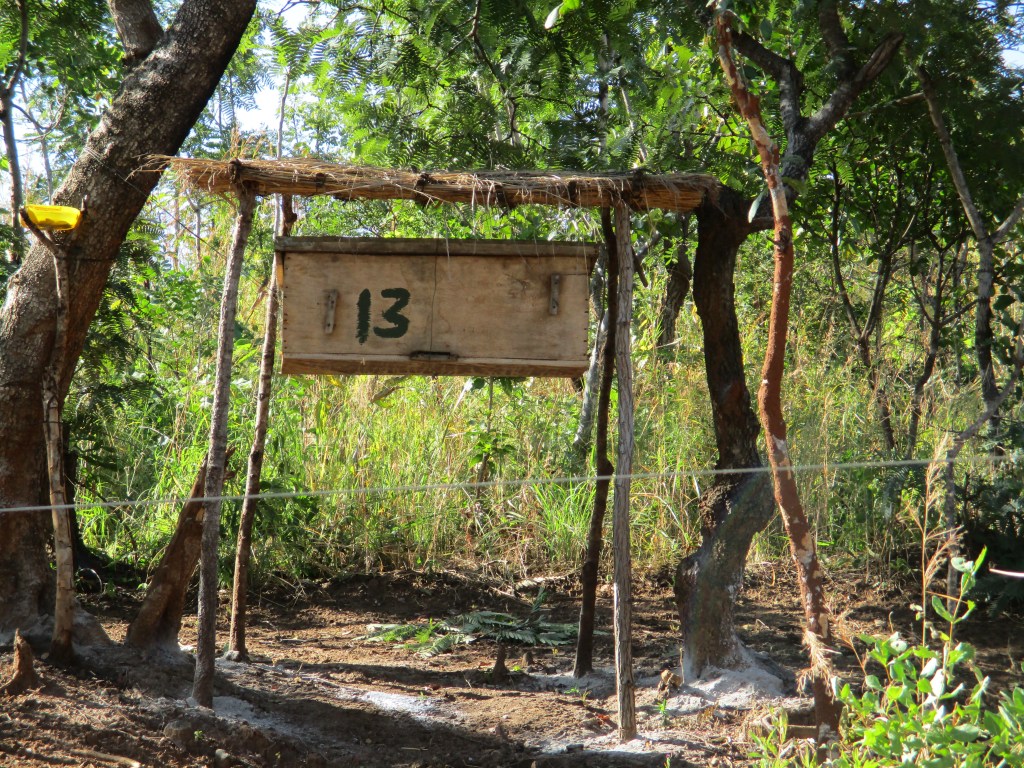
We visited several villages to see what programs WAG was supporting. WAG employs an agronomist to teach the local people how to grow and improve the yields in their gardens. They also supply poultry and goats which the villages can raise for protein, milk and to sell to provide income. They are taught beekeeping which is another generator of income.
Community garden
Bee hive. Raised to keep Honey Badgers and other animals out.
One thing three villages requested was a water well or borehole as it is called in Africa. We raised funds which were matched by other donors and the results were reported in a previous post.
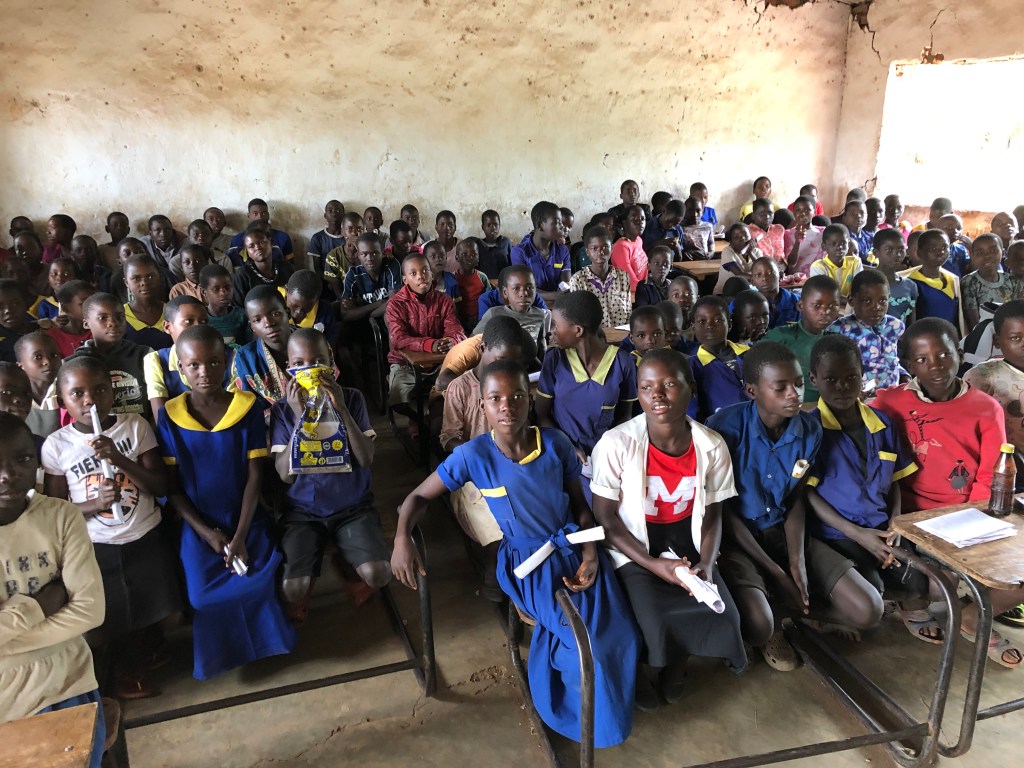
We visited an elementary and secondary school, meeting with the staff and visiting the classrooms. Elementary school is mandatory and free for grades 1-8 however it is horribly crowded. The one we visited had 832 students and only 13 teachers. A 64 to 1 ration is not very conducive to learning. The teachers however were dedicated and did their best for the students. High school is optional if the parents can pay for it, about $150/year. Unfortunately even this meager amount is well beyond the means of the average family. About 1 out of 25 children get an education beyond the 8th grade. After learning all this we started a scholarship program and pay for 10 students to attend high school each year.
Elementary classroom
High School class
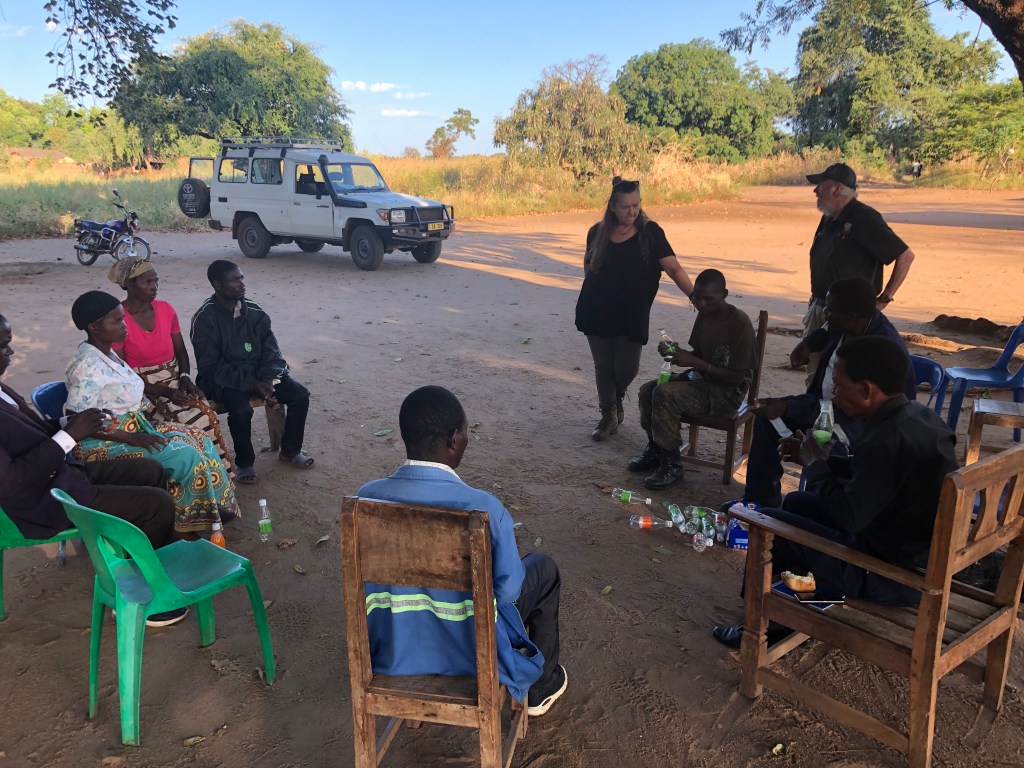
We were honored to attend a council of village chiefs with Lynn. The group discussed the problems they were facing and various solutions. We could not understand the discussions but Lynn told us one of the main concerns was the threat from local gangs who poached wildlife and cut trees for charcoal production. These are not individuals feeding their family but rather organized gangs who routinely were a danger to the locals as well as the rangers who patrol the forest. Rangers have been injured and even killed by these gangs. Lynn emphasized that the villages had to work together to support each other and report illegal activity to WAG or the local authorities. Elefence supports the rangers by awarding a small cash bonus of $3 for every successful apprehension and conviction of a criminal. Note that two of the chiefs were women. Transfer of power to a new chief passes through the mother and sometimes there is no male heir so it will go to the next female in line.
Council of Chiefs
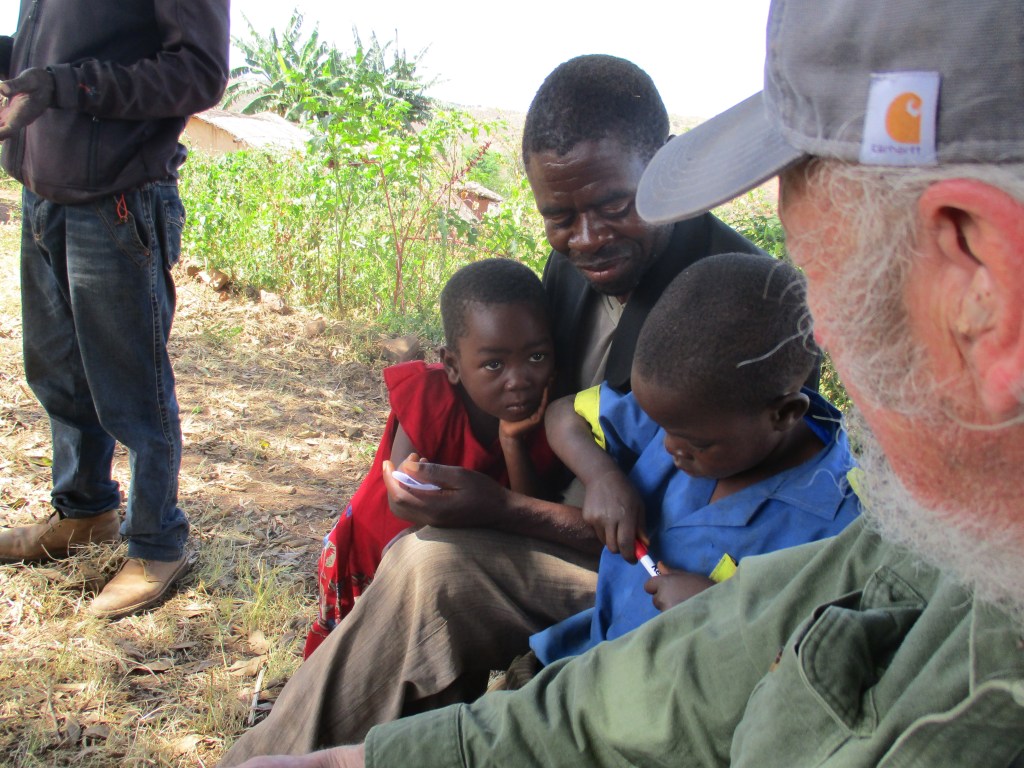
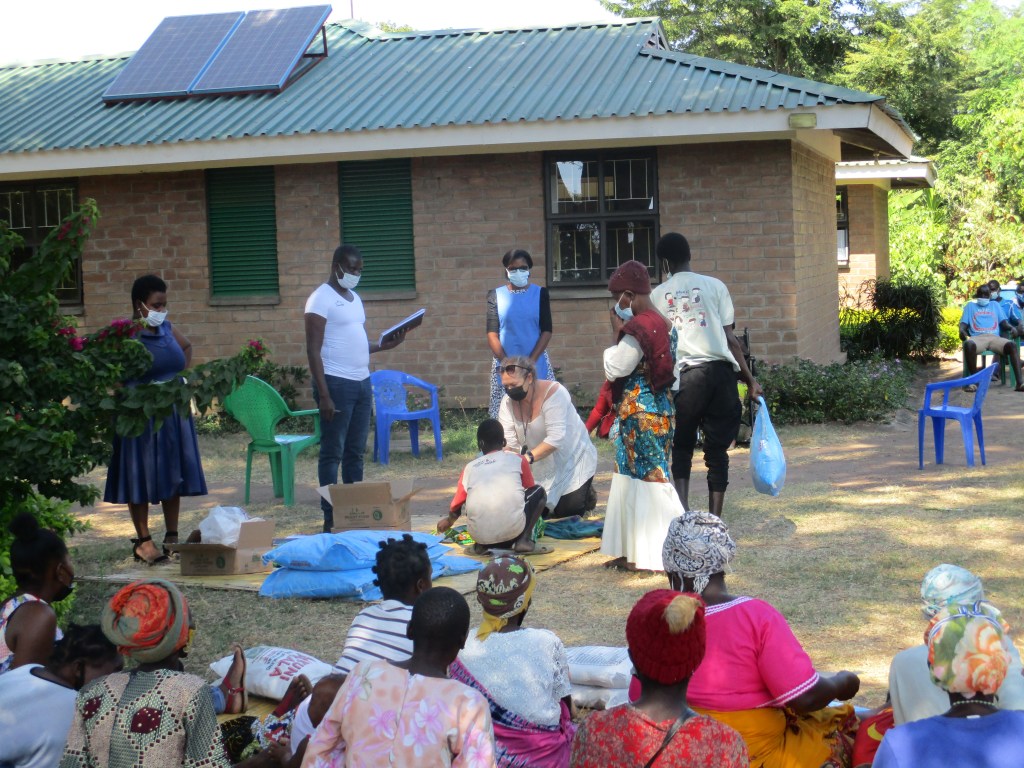
We visited what Lynn called “An end of life clinic” which is what we refer to as a hospice center. The clinic is funded by a charity from Ireland and Lynn sits on their board. They dispense pain and other medication to ease a person’s exit from life on earth. They also provide food for patients and their families since most of the patients cannot work. Most of the people in the photo have some kind of terminal disease and the clinic nurse told us that 90% the women which need the clinic’s services have cervical cancer. Lynn pays a nurse to make monthly visits to the local villages to educate women and urge them to come to the clinic to get tested before it is too late.
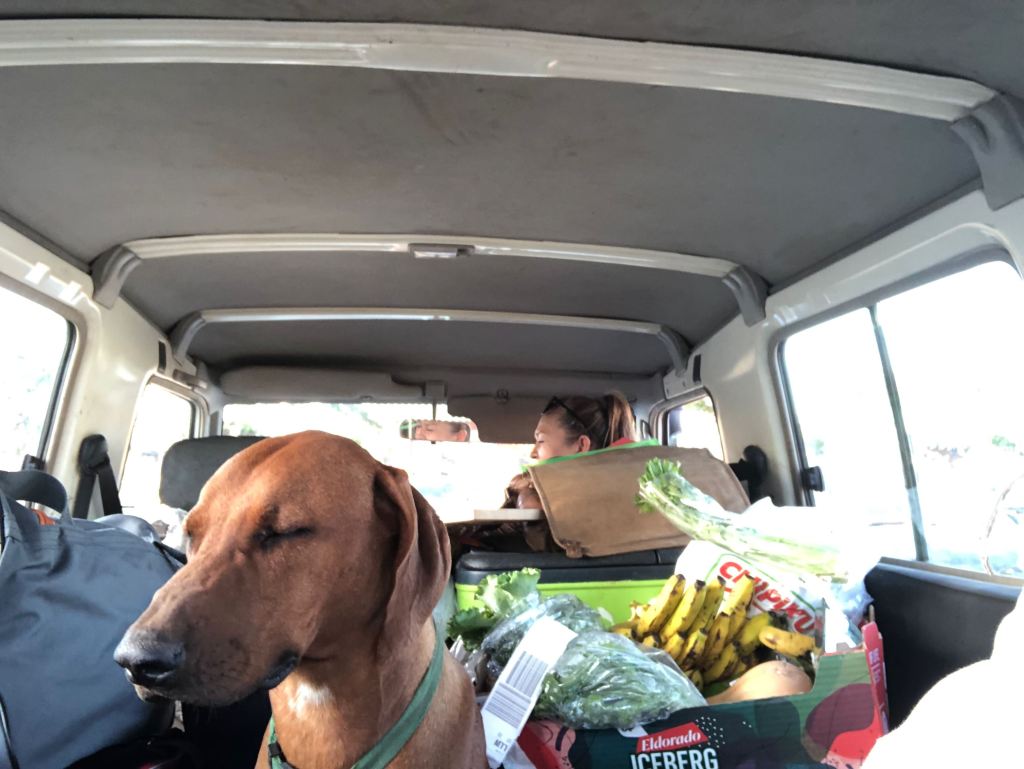
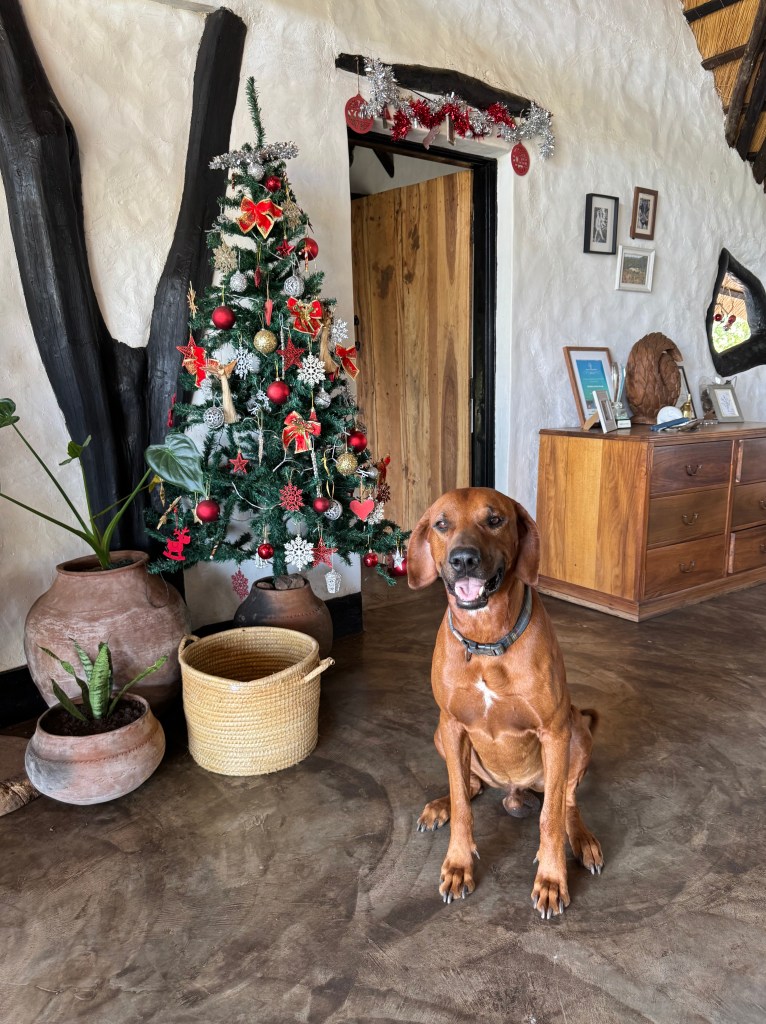
In the spring of 2022 Dick and I made the long and arduous trip to Malawi to visit our partner there, Wildlife Action Group (WAG). We started in Cleveland, OH and flew from there to Newark Liberty airport where we boarded a United Airlines 787 Dreamliner for the 15 hour flight to Johannesburg, South Africa. We cleared customs and stayed overnight in a small guesthouse near the airport. The next day we went back to the airport and took an Ethiopian Air 3 hour flight up to Lilongwe, Malawi. Lynn Clifford, the WAG field operations manager met us and took us on a 2 hour drive back into the WAG base camp in the Thuma Forest Reserve. Lynn had taken the trip to the city as an opportunity to pick up supplies for the camp. Dick rode up front with Lynn in the Land Cruiser and I rode in the back with the supplies and Lynn’s dog, Tarik.
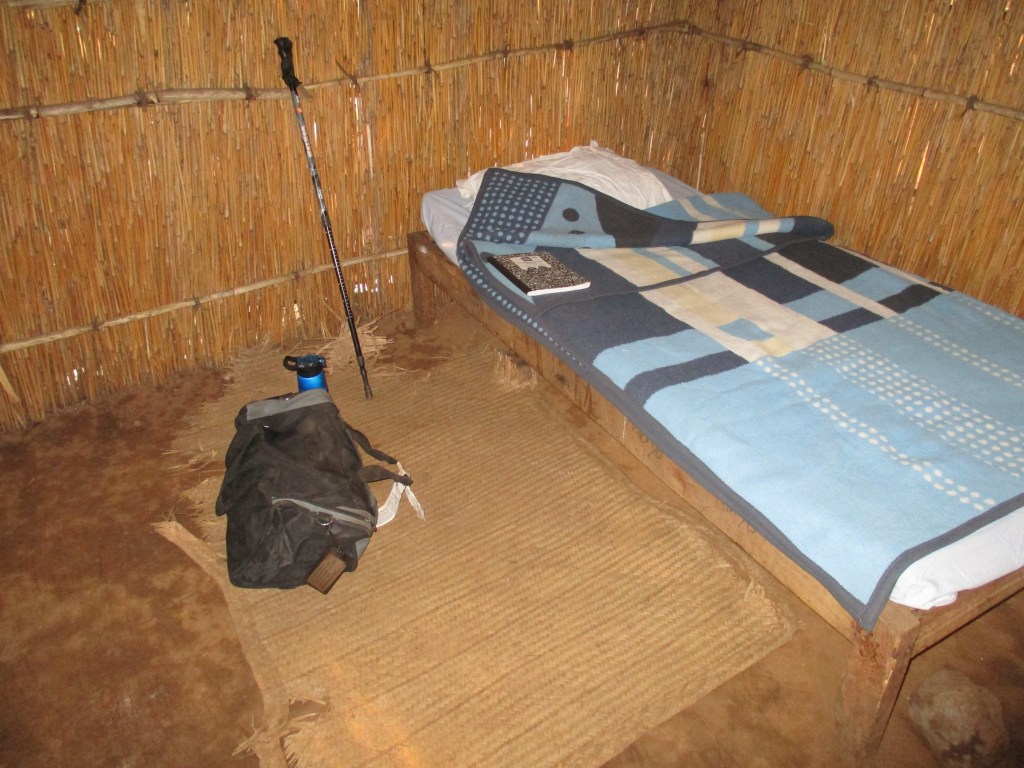
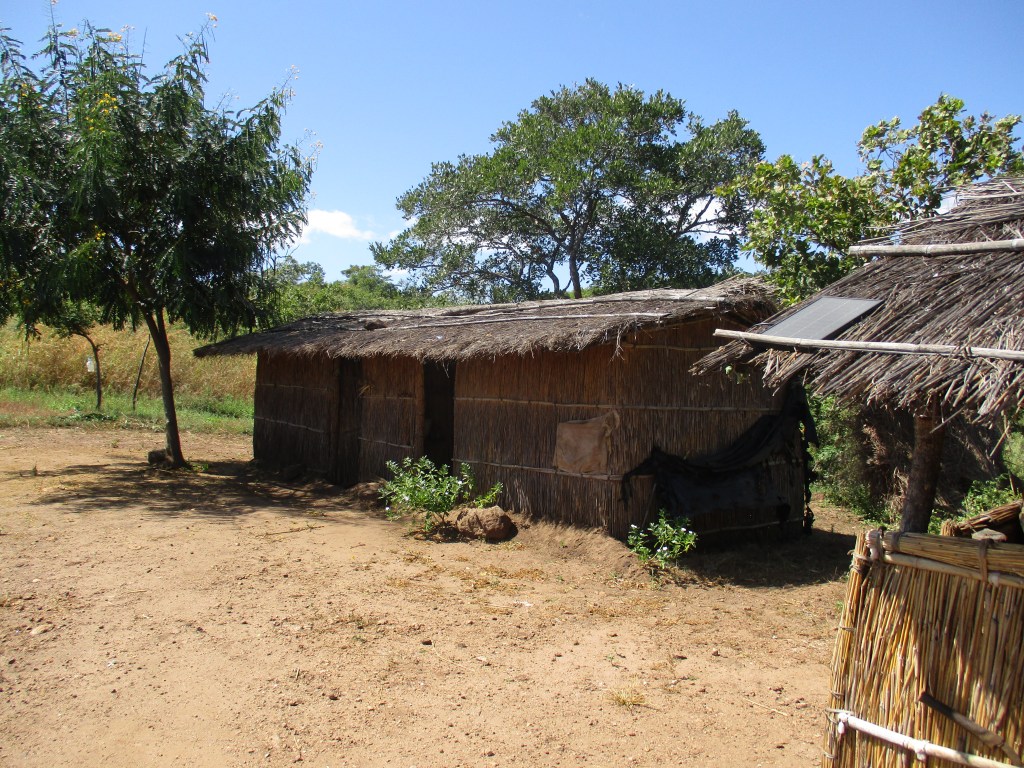
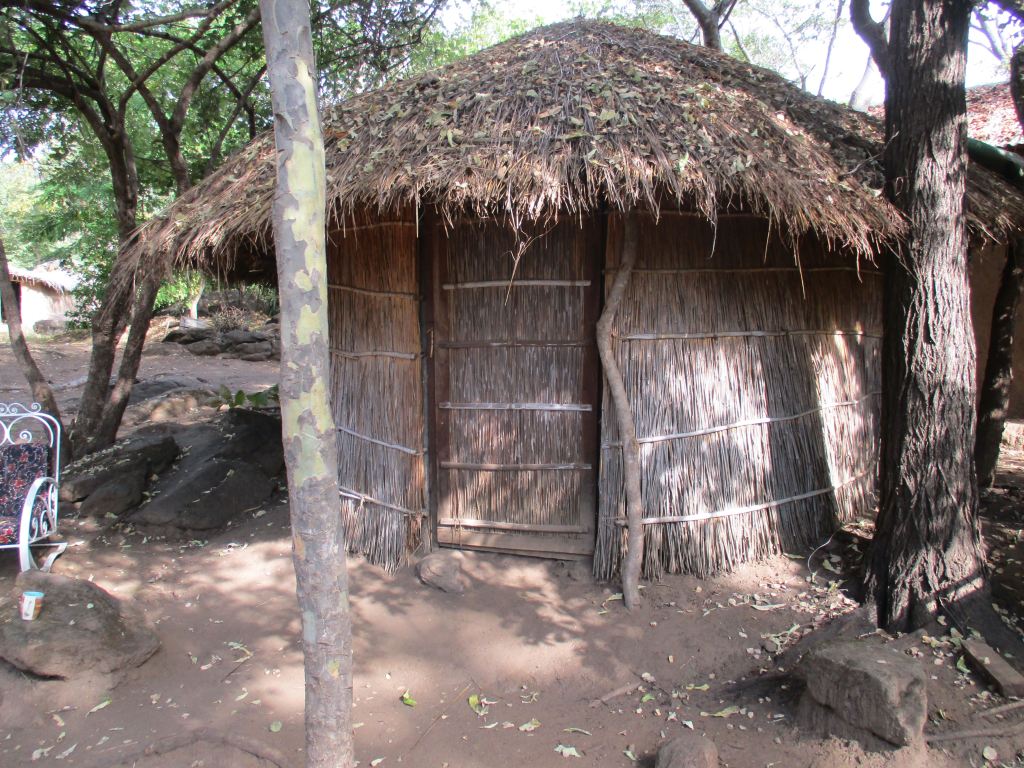
Upon arrival at the base camp Lynn gave us a quick tour and showed us our quarters for the next two weeks. We had two grass huts about 9 ft in diameter. Inside was a bed surrounded by mosquito netting, a chair, a shelf unit on which we could store our gear and a small table with a candle and matches. The floor was dirt covered by a grass mat. There was just enough room to stand up to get dressed. I shared my hut with a small lizard who skittered around chasing bugs, a bat which flew in and out occasionally and a large black spider who climbed up the netting. I dispatched him with my shoe the second night. Dick shared his tent with the camp cat, Kango, which means lion or panther.
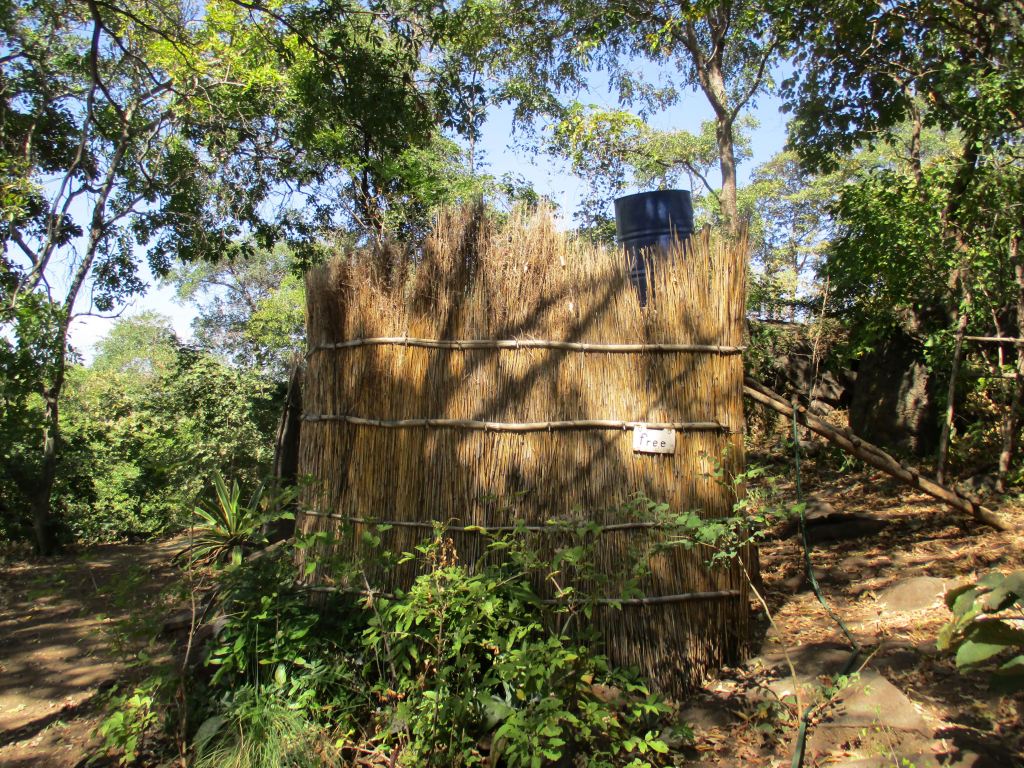
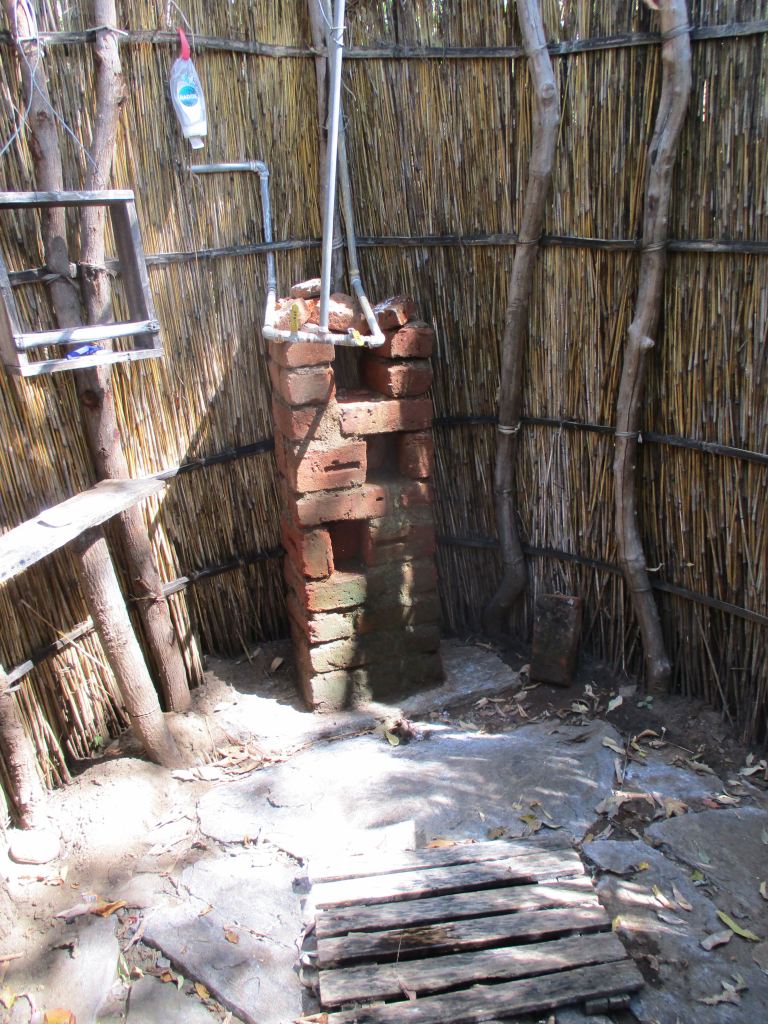
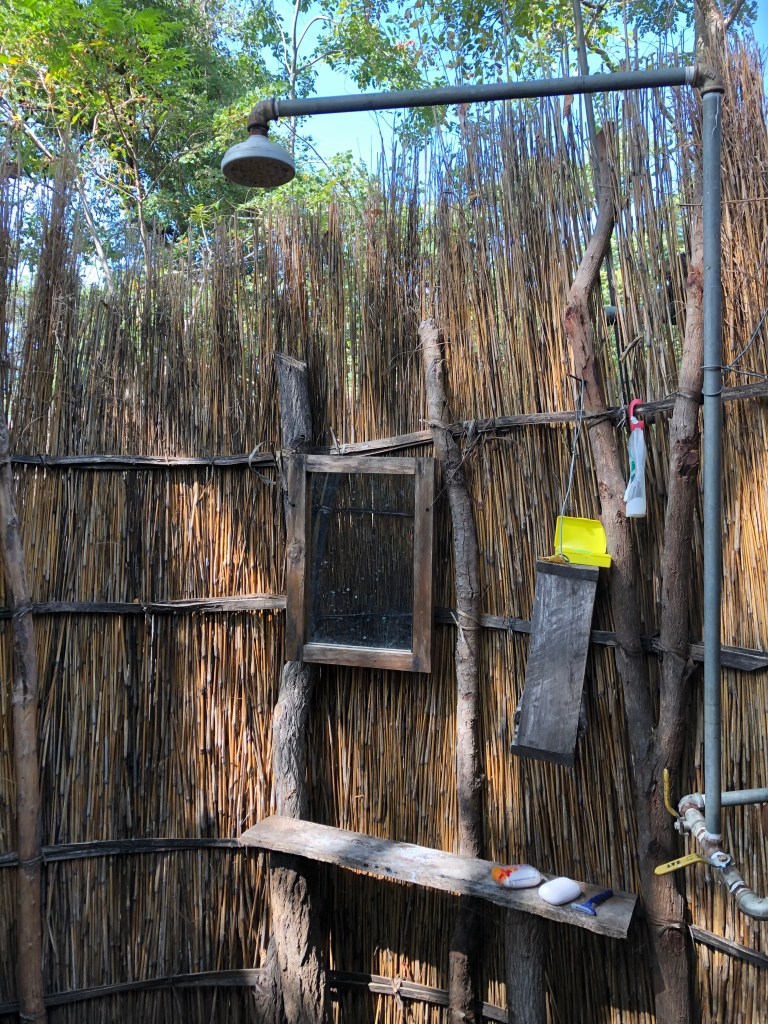
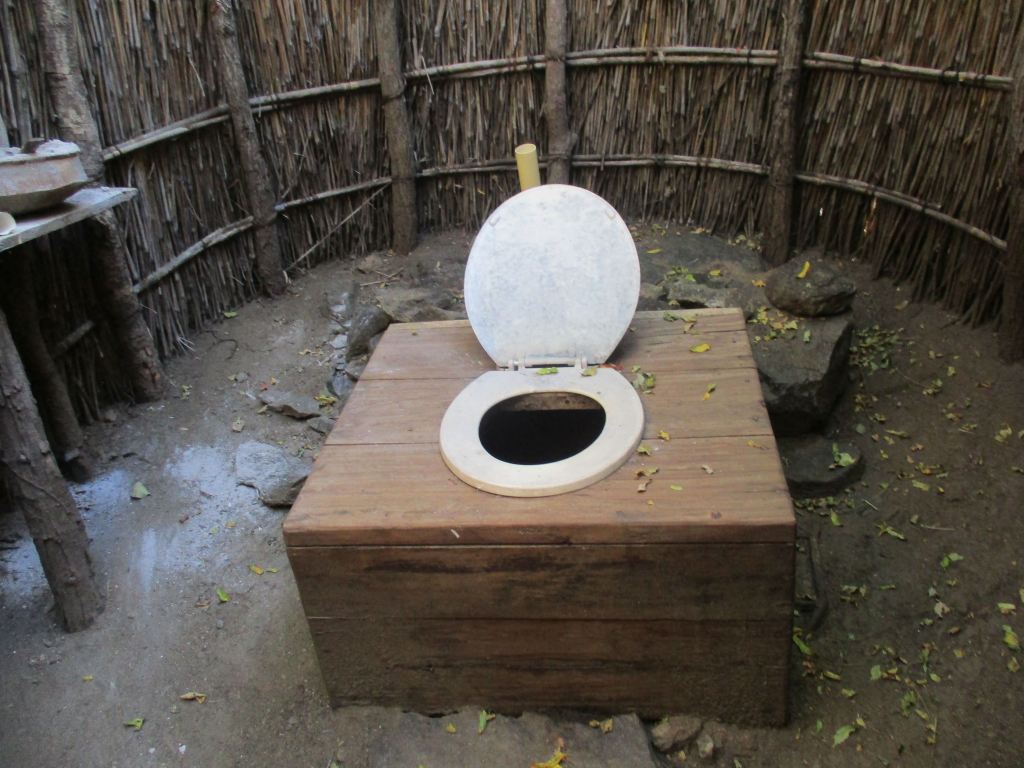
Down the hill from our huts was a shower hut. About every second or third day the camp crew would light a fire under a large drum to heat water for our showers. Further down was the latrine which Dick christened our Martha Stewart toilet.
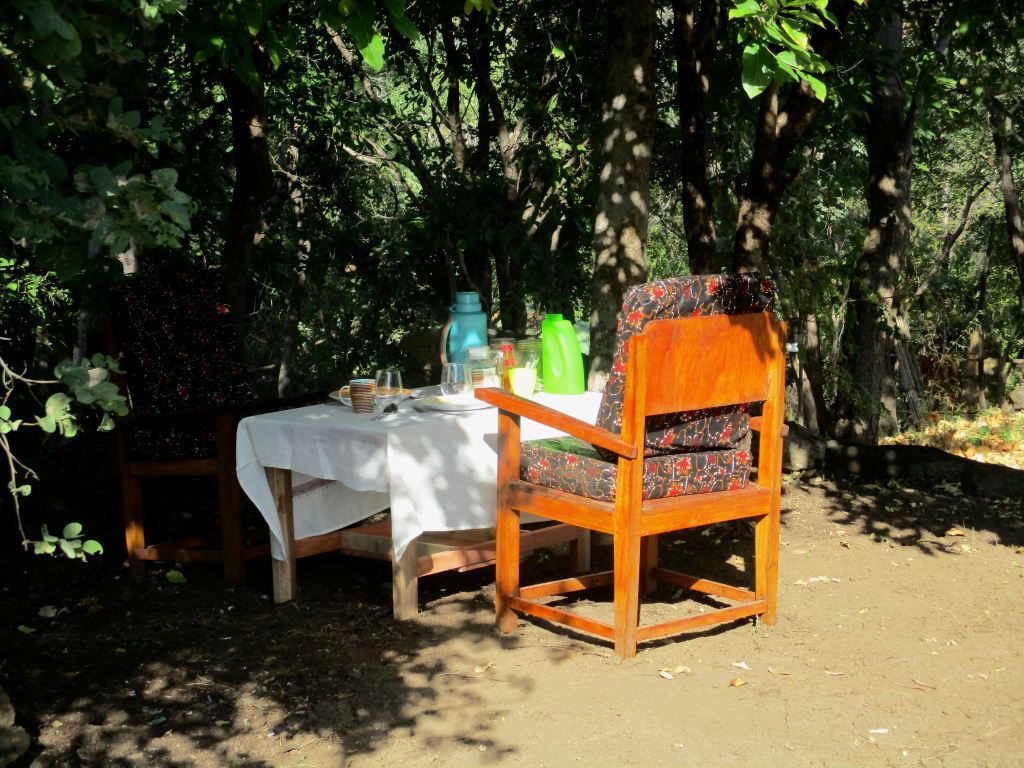
Up the hill was a small flat area with a table at which we had breakfast and lunch if we were not in the field. Further up was the camp office and a small room with a table and chairs where we ate our dinner.
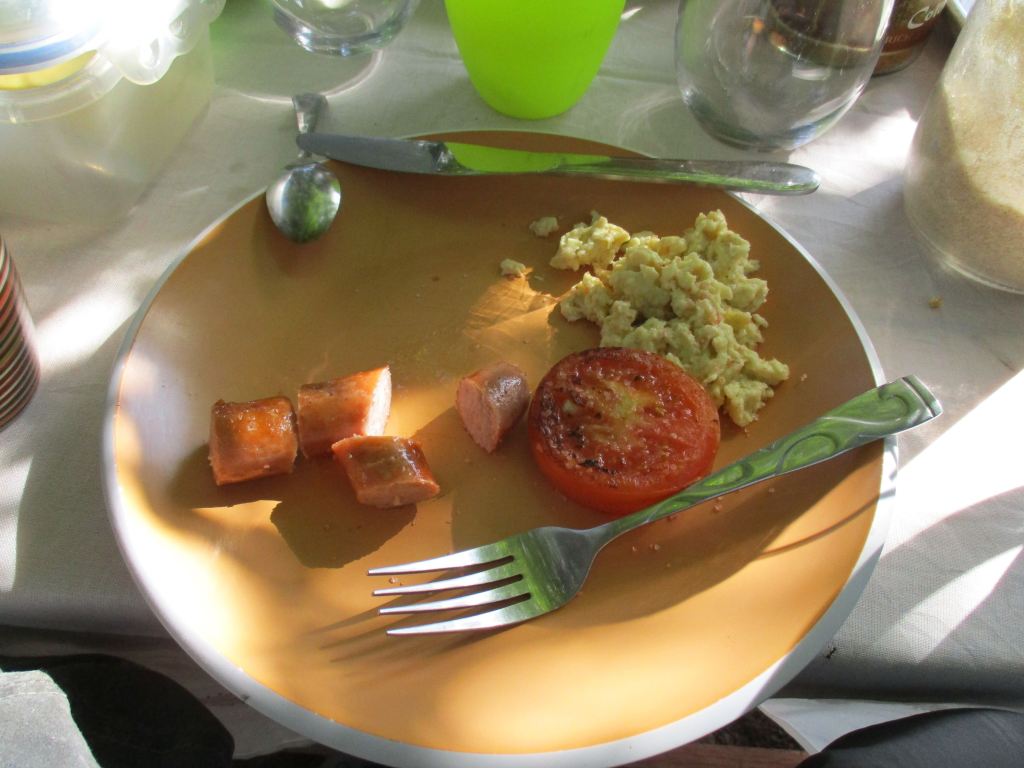
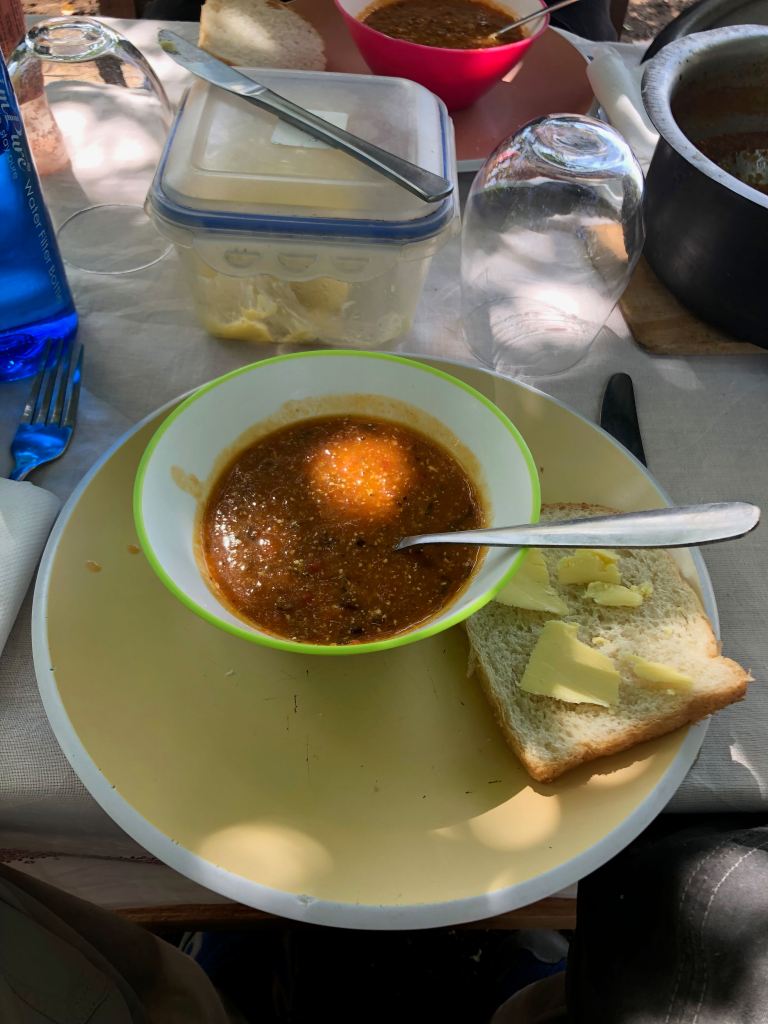
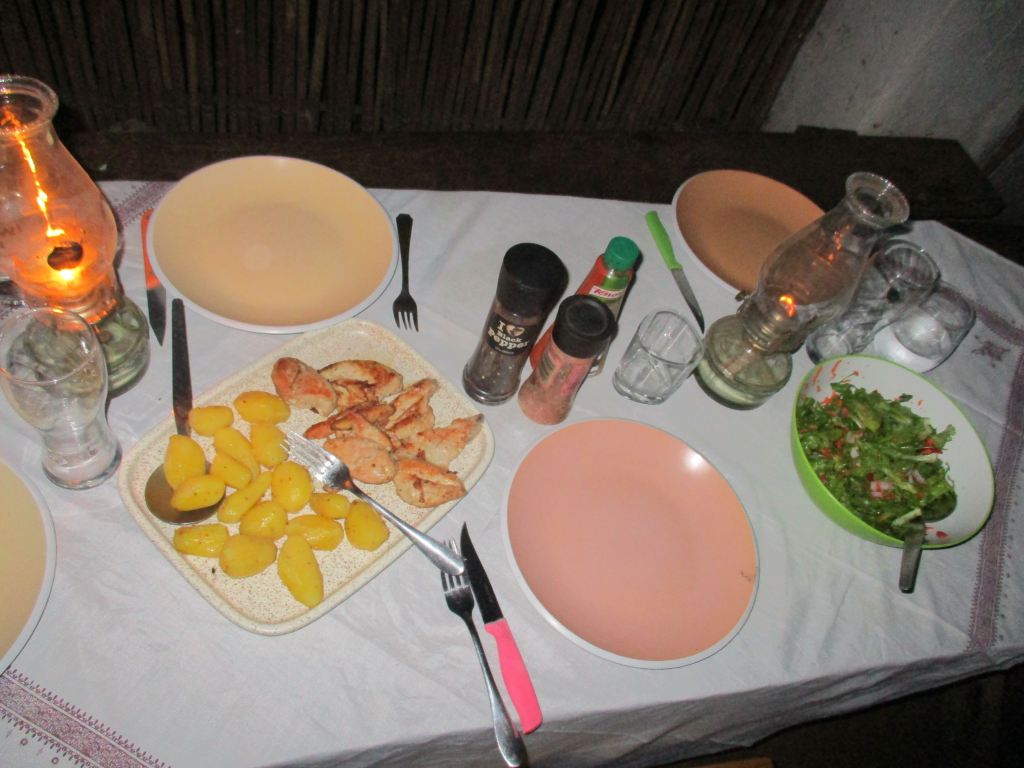
Our meals were prepared by a cook and were simple but surprisingly good. Breakfast was usually scrambled eggs, sausage if you wanted it and toast with butter along with strong black coffee. Lunch, if we were not away in the field, was usually a thick vegetable soup with bread. Dinners were roast chicken, spaghetti, or beef accompanied by potatoes and a salad. What might be left over one night was served again the next. Previous to our meals was usually ‘Sundowner Time’, wine or a G&T and we sat around a fire and listened to Lynn and Dick exchange stories about their time in the bush. It was entertaining to say the least.
Dick with our cook, Facsome.
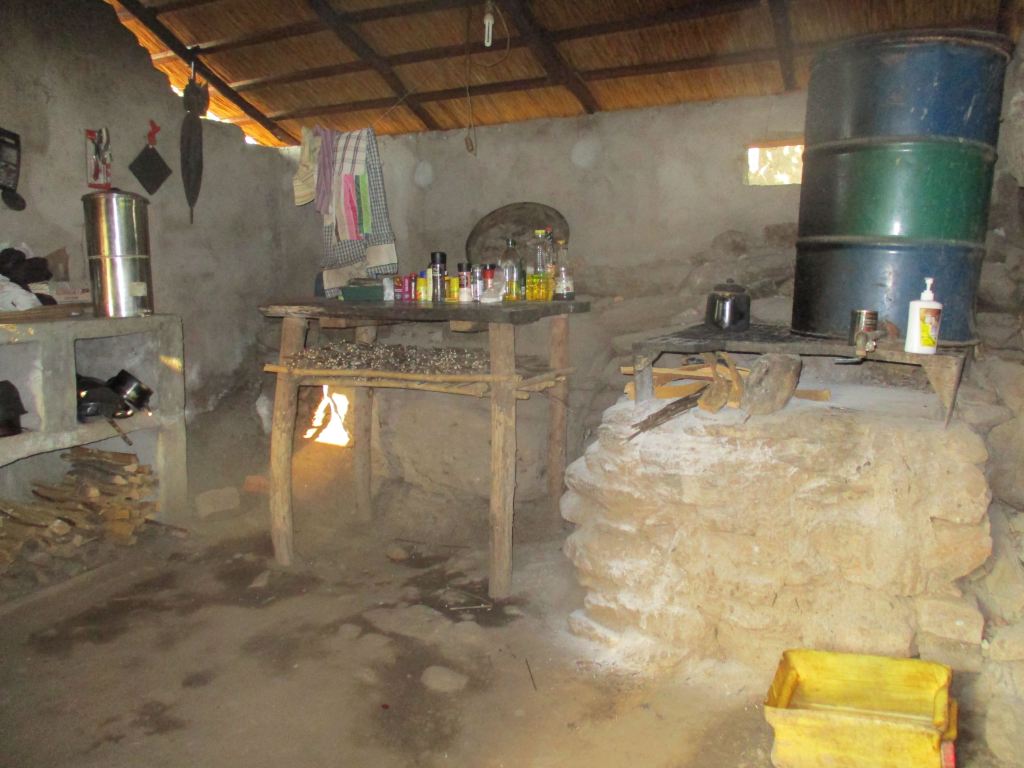
Camp kitchen
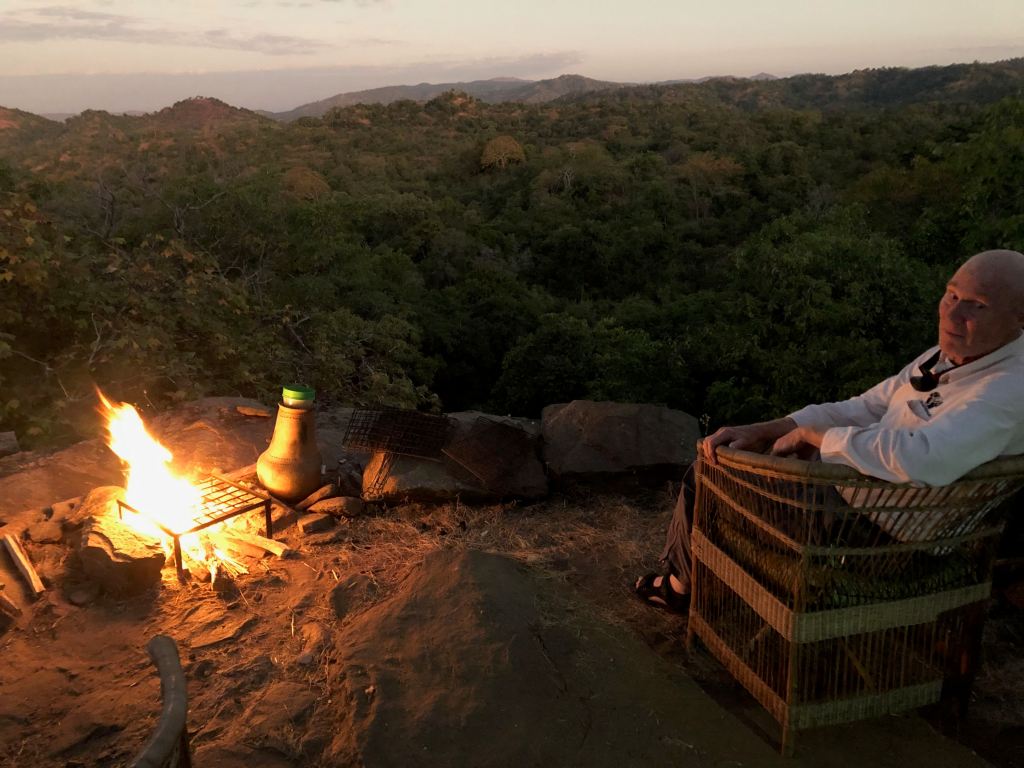
Evening sundowner
So ends part 1 of our time in Malawi. Part 2 will describe our experiences during the two weeks we were in Malawi.
Contributed by Erin and Marianna B., Elefence supporters
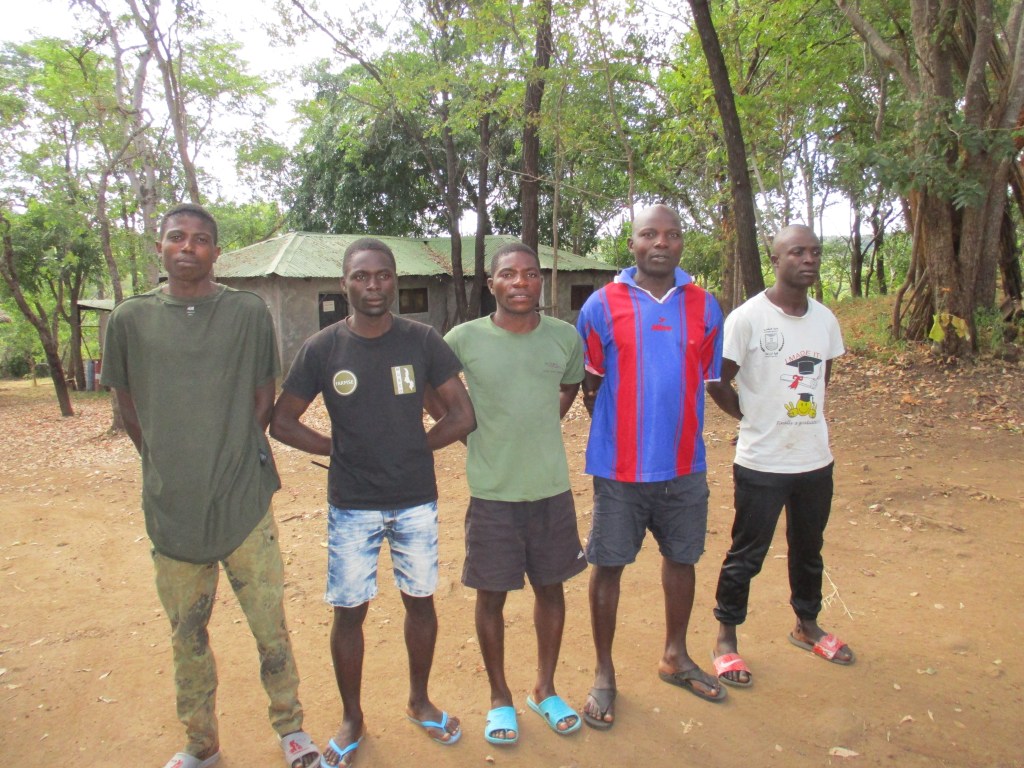
In an exclusive interview, brave canine cadet in the combat on poaching, Tarik, tells us about the dangers of life in the African bush–and why it’s worth the risk. After a concerning announcement was made by Wildlife Action Group and its partner organization, Elefence, on the rise of poaching in Malawi, we caught up with Tarik, one of WAG’s most devoted staff members, to learn more about the crisis. EB&MB: Tarik, thank you for taking the time to speak with the us about your mission in Malawi. After reading our interview with Dick Houston and Jon Stevenson of Elefence International last year, our readers may already be familiar with the work of Elefence and Wildlife Action Group in attempting to heal the poverty and poaching crisis which affects the lives of both people and animals in Africa today. However, we’d like to learn more from you about what life is really like on the ground for a WAG officer. Could you tell us a bit more about yourself? TARIK: “I’m a Rhodesian ridgeback, and my name means ‘Star,’ as I have a white 4 pointed patch on my chest which is somewhat typical of my breed. My sidekick, Lynn Clifford, is Field Manager for Wildlife Action Group, which is a Malawian non-profit conservation NGO. Our mission is to protect and restore Thuma and Dedza-Salima Escarpment Forest Reserves.” So how does your specific breed help you to carry out this mission? TARIK: “Well, my breed was originally developed in Rhodesia, now called Zimbabwe, where we were trained to hunt lions. So we can be really brave on the job. But actually, I myself had a very close call with a warthog. It was the last time Dick and Jon of Elefence were out here, and I can tell you, I learned a lesson the hard way. I took off chasing a warthog–because, you know, I can’t help myself–and unfortunately I came back with a large gash on my hindquarters. And that wasn’t my only close call. Here in Malawi, there are a couple of diseases carried by flies that are usually fatal to dogs. I barely survived one just before Dick and Jon arrived at the WAG base camp. The cure is almost as bad as the disease as they administer what is basically a poison to kill off the infection and many times the medicine kills the dog…but not me! Life is dangerous for a dog in the African bush, so I have to be brave, but my friend Jon says I’m just a big friendly puppy.” And as we’ve recently heard, life isn’t just dangerous for the dogs. Can you tell us about WAG Rangers’ recent encounter with poachers? TARIK: “Sadly, poaching is on the increase in Malawi and that keeps me and my co-worker, Lynn, busy on the job, trying to protect the special animals who live here and the forest they inhabit. It’s important to note that these poachers don’t hunt game for subsistence–no–it’s greed for profit. As Jon has told you before, pangolins, for instance, can be poached and sent as far away as China just to make a profit on the market for animal parts. And like pangolins, many of these animals–elephants, warthogs, kudus, duikers, and more —are threatened species, and on average a team of poachers can kill up to three animals each time they hunt! A huge loss for the Malawian government and the country’s prospects of being a tourism destination! It also touches me personally, because the poachers use dogs. The dogs track, hunt and catch the animal quickly which is then hacked and or speared to death by the poachers. I’m here to show that dogs can play a positive role in conservation. Between September and December 2024, our dedicated WAG rangers caught eleven dog poaching teams. I want to show that dogs can be on the right side of this war on wild animals.” And how do you help to play a positive role in supporting your fellow soldiers, Tarik? TARIK: “Well, I’m Field Manager Lynn’s constant companion. Basically, I’m her First Lieutenant. Together we make sure base camp is supplied and our rangers are supported. Poachers are aggressive and rangers are assaulted in the course of their duty! These rangers only make $3 bucks a day. That is why we rely on generous donors to keep these men in the field. Otherwise poachers would overrun the forest and kill more and more wild animals to oblivion.” WAG Rangers recently made several important arrests. Were any rangers injured in the line of duty? TARIK: “Yes, one of my ranger friends was badly injured, and I’m including a picture of him here just to show how brave he was. I knew how much that must hurt when I thought about my warthog gash. And poachers are scarier than warthogs. They go armed into the forest with dogs, bows, arrows and spears! They don’t understand what we’re trying to protect–but, like Nelson Mandela said, “If we do not do something to prevent it, Africa’s animals and the places in which they live will be lost to our world and her children forever.” So we are here taking these risks. Last week two suspects were arrested and this morning our brave anti-poaching rangers arrested 3 more, one being one of the most notorious poachers from Dedza who has been a very large thorn in our side all of this year! A second offender! All suspects have been handed over to the police for prosecution. Another win for our rangers!!” Tarik, our Head Biologist, who is both a dog lover and passionate conservationist, is concerned about the fate of the dogs involved in the poaching. What happens to them when the poachers get arrested? TARIK: “Many times the dogs escape when the owners are caught and run loose to kill again. Sadly the dogs that are caught must be euthanized. They have been trained to hunt and bring down game and are loyal to only one master. Lynn is a dedicated dog lover, and she and I are heartbroken that this step has to be taken but there is no hope of rehabilitating these dogs. It is our goal to make poaching with dogs so unprofitable and have such strict penalties that the practice will stop. Life is hard in the African bush–but it’s worth it.”
Interview conducted by Erin B. and Marianna B., with the assistance of Lynn Clifford of WAG and Jon Stevenson of Elefence.
Martin and Osa Johnson. The FIRST motion picture explorers in history. In this photo, Martin and Osa film the Samburu warriors in northern Kenya, 1920s.
Martin and Osa Johnson were a swashbuckling husband-and-wife filmmaker team who “invented” the first non-hunting wildlife movie documentaries in history — long before Animal Planet.
PART ONE:
In a previous Elefence Blog post, we presented a video about Martin and Osa Johnson called “Wings Over Tanzania.”
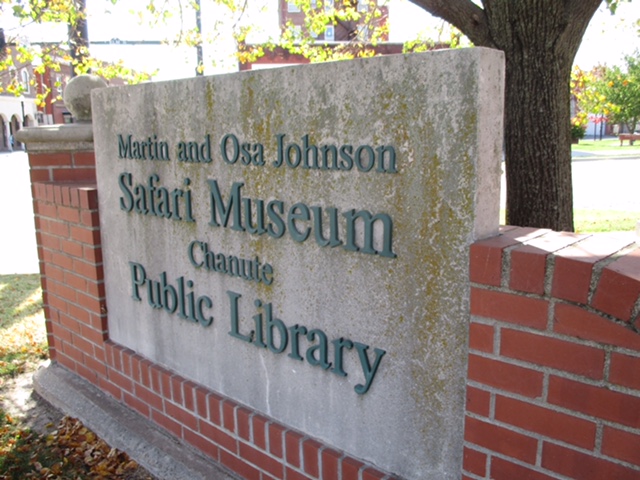
One of the most unique museums in the world preserves the lost wildlife and tribal worlds of the Johnsons: the MARTIN AND OSA JOHNSON SAFARI MUSEUM.
The Museum is based in Chanute, Kansas — OSA’s hometown.
The Museum’s Director, Conrad Froehlich, is an Honorary Trustee of Elefence International.
Note: parts two, three, and four will follow in subsequent posts.
The Martin and Osa Johnson Safari Museum is the epicenter of the motion picture history of pioneering African safaris, Borneo, and South Sea Island adventures in the early 1900s.
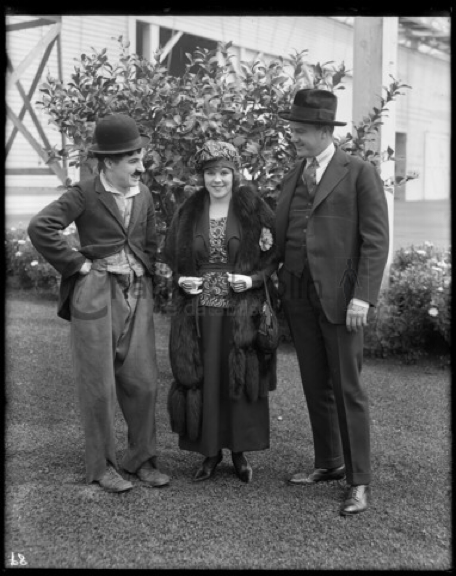
In the 1920s and 30s, Martin and Osa Johnson were household names as recognizable as Charlie Chaplin, Douglas Fairbanks, and Amelia Earhart.
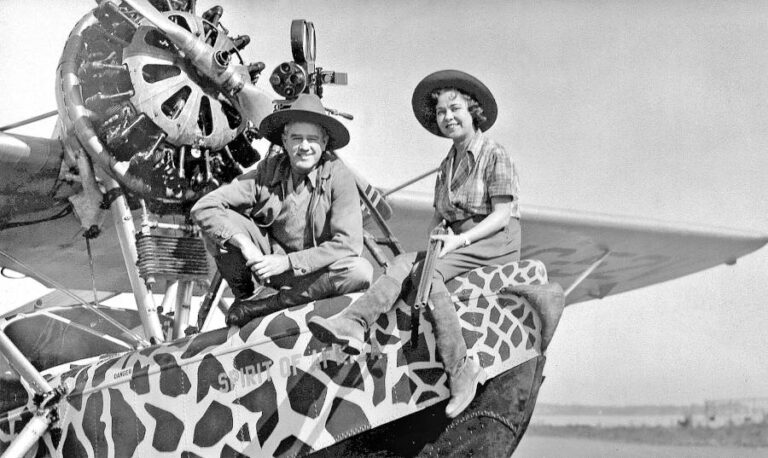
The Johnsons pioneered flights over Africa — some 60,000 miles over the Dark Continent of unexplored jungles. They used two Sikorsky amphibious planes, necessary to land on rivers and lakes since there were still few wilderness airstrips in Africa in the early 1930s.
They barely survived some harrowing near-death-defying experiences in flight. At that time, there was no radar, no airfield radio communication in remote Africa locales — flying blindly into horrific rain storms with ZERO visibility. One can only imagine the terror — and the guts it took to do that. As a result, they preserved aerial images of once pristine landscapes that no longer exist.
No wonder their motion pictures were always box office hits on Broadway — and at hometown theaters across America and around the world. The Johnsons also pioneered the first all-talking sound motion pictures in Africa.
Please stay tuned for Parts two, three, and four in succeeding posts. We’ll tell the fascinating story of the Johnsons in a little more detail. And how their historic photographic record is preserved — including their one-of-a-kind original artifacts of exotic travels — at the award-winning Martin and Osa Johnson Safari Museum.
And learn how the facility is a living museum today for research — and creates awareness for preservation of endangered elephants and Africa’s shrinking wild places.
There are few places on earth where one can walk with wild elephants. Mana Pools in northern Zimbabwe is one such place.
When approaching elephant bulls while walking, it is important to remain downwind undetected (the elephant’s scent is blowing towards you) as most animals are instinctively fearful of man on foot.
Some bulls in Mana Pools can be extremely relaxed and accepting of humans. The trick is finding out which ones are ‘friendly’!
I was walking with some of my guests when I spotted this young elephant bull eating fallen pods from a winter thorn tree. This tree has extremely nutritious, protein-rich pods and are sought after by many animals in Mana, especially elephant.
We slowly approached to within a safe distance, where I purposely now allowed our scent to waft upwind toward the elephant! I didn’t want to surprise him. Elephants have an incredible sense of smell and could have picked up our scent from a huge distance away. I watched for his reaction. This is a simple way of gauging how receptive an elephant is to one’s presence.
It was at this time that I recognized the young bull as an elephant we called Toast — named after his habit of stealing toast off the camps’ breakfast tables! And I knew him well as a very calm bull.
I decided it was safe for us to edge ever closer to him. It was breathtaking as we stood under a tree and watched as he calmly walked around picking up the pods unperturbed by our presence.
As he ambled around the tree he slowly made his way towards us. This is when I placed myself in front of my guests. I then stood next to some of the delicious pods and knew he would soon approach, of which he did not disappoint!
Toast walked closer and closer and looked at me carefully, trying to ensure I was a friend and not a foe. After a few tense moments, he walked even closer till he stood right in front of me! Then he continued eating the pods.
He stood with me for some time investigating my scent with his trunk — and then suddenly turned and continued his search for more pods.
You can see why I love elephants. Their intelligence for sizing up a situation never ceases to amaze me.
Nic Polenakis Safari Guide and Elefence trustee
Elefence addendum: Nic is a certified professional guide who was named by National geographic as one of the top ten safari guides in Africa. He has the uncanny ability to read wildlife, especially elephants, which is how he is able to get so close as pictured above. He is not a hunter, but is required to carry a rifle in order to protect his clients in an emergency. Check his website http://www.myprivateafrica.com
Part two by Dick Houston WHAT MAKES A GREAT SAFARI GUIDE?
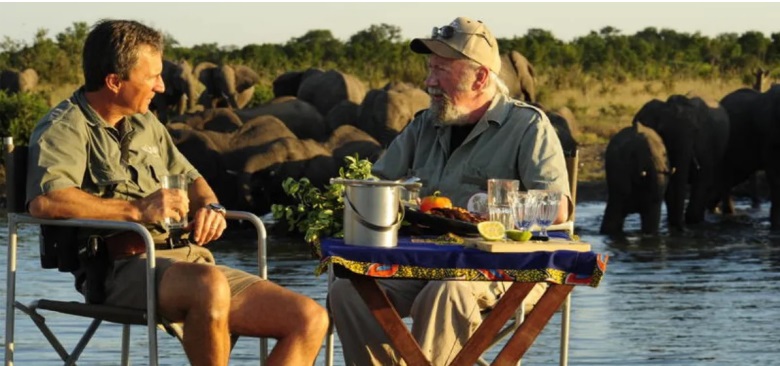
Nic Polenakis with friend Dick Houston of Elefence at a waterhole with unexpected thirsty guests. Hwange National Park, Zimbabwe
Part Two:
Later having sundowners by a waterhole in Hwange park, Nic and I start our stories regarding our separate experiences on operating safaris all over Africa. Nic has a quick wit and keen sense of humor, and we laugh a lot. We talk long into the night… Relaxed around safari fires with drink in hand, you can talk freely and be yourself. You really listen and get to know people. Nic is one of the most unassuming and honorable men I’ve ever known. Over the years I’ve seen he’s a devoted family man. I know his lovely wife Tracey and his animal-loving 13-year-old son Chris (who has an ever-grumbling Jack Russell named Grumpy, and a cool pet rooster named Mister Cheep Cheep!)
I ask Nic what first inspired him to live and work in the bush — and what he had to do to make his dream come true as a non-hunting safari guide. Nic thinks a moment and then tells his story to me… “You know, Dick, being trained as a professional guide in Zimbabwe, where I was born, is extremely arduous. And is arguably Africa’s toughest and most rigorous professional guides examination process.
I served my 3 year apprentice on a rhino conservancy under a fully qualified professional guide where I mastered the basics of bush lore, tree identification, animal behavior, mammals, birds, arthropods, star gazing, general knowledge, shooting, safety, advanced first aid, spoor and skull identification, mechanics and much more.
During this learning period I had many exciting forays. I lay in ambush against poachers, climbed trees to escape black rhino, was charged by elephant, stood face to face with 3 black mambas! Then, of all things, I had a close shave with a domestic Brahman Bull! Yes you heard right! I will never forget being told to go and destroy a Brahman bull that escaped its pen, and was running wild and could not be captured.
I couldn’t believe this easy task; I mean if it was a Cape buffalo it would be one thing but a domestic bull?! This was surely no challenge at all…
I finally located the ‘’wild animal’’ and after setting up an ambush I stood on a path and waited for it to approach. The huge Brahman bull ambled towards me, raised his head and charged! I was taken totally by surprise and raised my rifle and fired in time, dropping him only feet from me! This was nearly an embarrassing situation, one in which I don’t think my fellow colleagues would have let me off so lightly!
After passing the stringent professional guides written exam, I was invited to the shooting practical exam where shooting both moving and fixed targets set at varying distances, where speed, accuracy, weapon handling and safety were paramount. This is a crucial aptitude when you are responsible for the safety of your clients on walking safaris into the bush.
Years earlier and after making my mind up that I was going to be a professional guide, I purchased a .458 Winchester mag and took it to the range to try it out. Sitting on the ground I raised my rifle, took aim at the target and slowly squeezed the trigger. After the dust had settled and my ears normalized, I sat there in total disbelief and shock!! My shoulder felt like it was broken, and I think I missed the target all together! What came to my mind was how on earth was I to one day become proficient at shooting this thing?
After passing the shooting exam, I was invited to the next step: a daunting oral interview where one sits in front of his peers and is bombarded with questions. This is then followed by the dreaded ‘nature table’ where one has to identify skulls, tree pods, arthropods, bird feathers, nests and seemingly endless ‘artifacts’. Only candidates whom the panel deem competent, and ready for the last hurdle, are invited to the final practical exam.
This one-week-long practical exam is legendary, and not for the faint-hearted. Here, a total of 20 plus aspiring professional guides, are broken into groups of 4 to 5 hopefuls. They are expected to set up their tented camp and host some of the examiners. There is no place to hide and you are expected to excel. It is grueling, tiresome and nerve-racking where one is examined on everything and anything!
When I took the learner’s examination there were over 200 candidates. By the time the practical exam arrived 3 years later, there were about 20 of us left — of which only 4 passed. I was one of them.…”















 Elefence International, Inc.