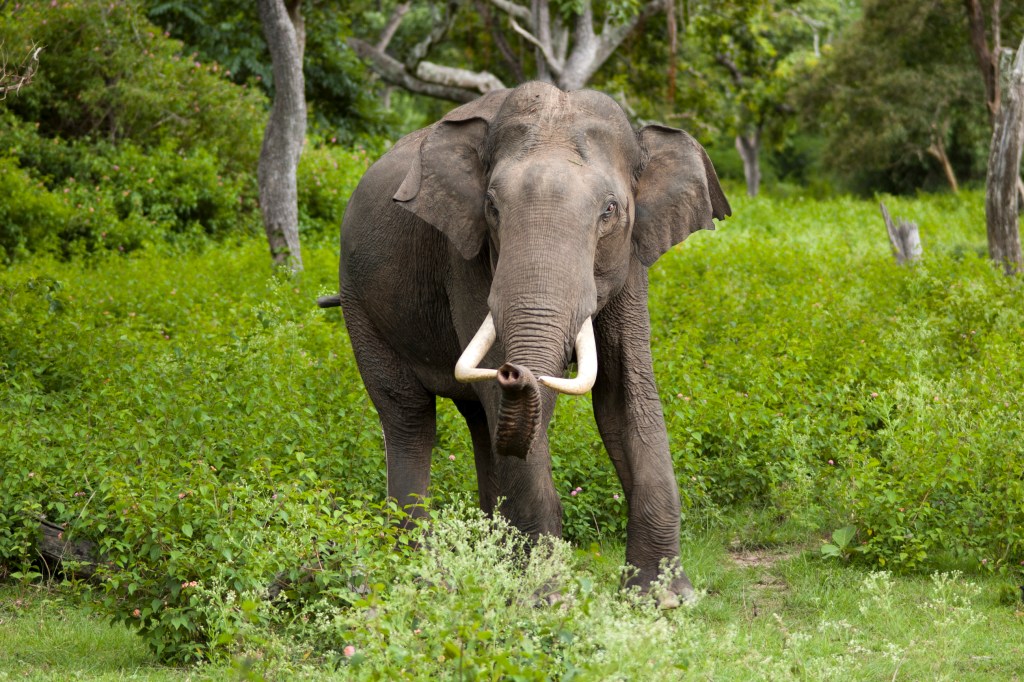
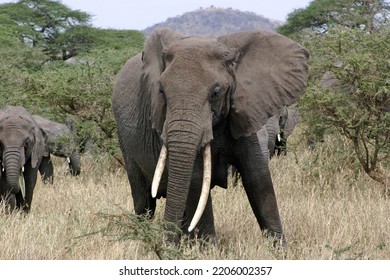
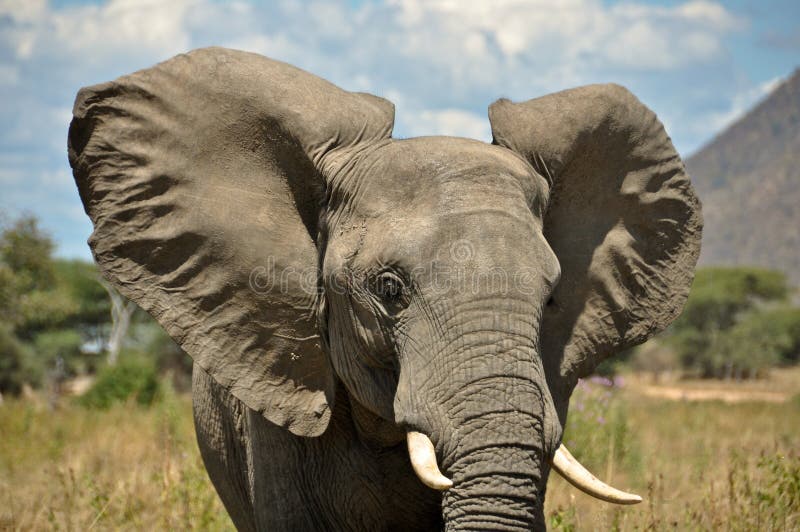
There are two species of elephants on earth today. The African elephant and the Asian elephant. They are genetically different but easy to identify just by looking at their head and ears. For the most part however they share the same traits and abilities so we can consider them as one species. Zoologists break down the African elephant into two sub species, the bush or savannah elephant which lives in more open areas and the forest elephant which lives in jungle or wooded locations. Once again however we can really consider them as one species.
African elephant
Asian elephant
Elephants are the largest land animals alive on earth today. A mature African bull elephant can stand 13 ft tall at the shoulder and weigh upwards of 7 tons. It is difficult to appreciate just how big they are unless you are up close to them or you see them next to a familiar object.
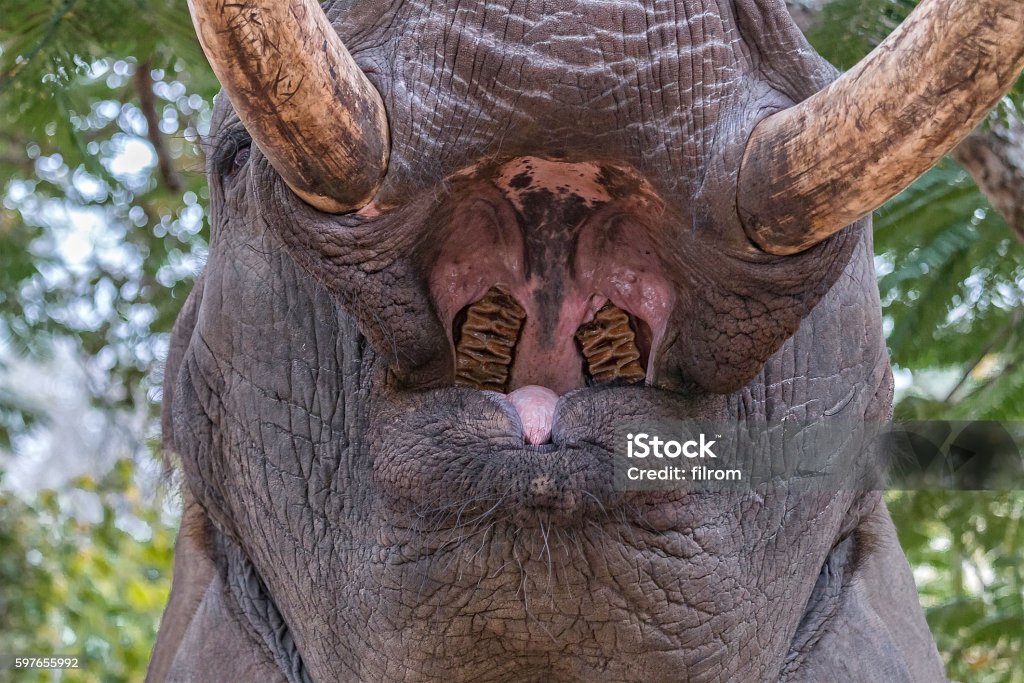
Elephants live on average to between 60 and 70 years of age. They have 5 to 6 sets of molars in their jaws with which they use to grind their food. As the ones in the front wear down and fall out the ones in the rear move forward to replace them. When the last set is gone they can no longer properly feed themselves and basically die of starvation. Sadly elephants kept in zoos die at around 40 years of age. Elephants are hard wired to move about and travel freely and they need the social interaction with other elephants. The stress of captivity significantly shortens their life. Remember this when you see an elephant at a zoo.
Close up of an wide open elephant mouth. It shows anatomic details of the elephant throat like its teeth, tongue and the roof of the mouth
Elephants are right or left handed just like humans. You can tell by observing which tusk is worn down more than the other.
Left handed elephant
Right handed elephant
The saying that ‘An elephant never forgets’ is very true as they have amazing memories. Their brain is 4-5 times larger than a human’s, is very similar in construction and much of it is dedicated to memory. They navigate long distances by remembering the directions and trails they have taken in the past. They remember the location of waterholes and can recognize individual elephants they’ve had a relationship with in the past.
They can remember the location of fruit trees and when the fruit will ripen and fall to the ground. Elephants routinely push over small trees to get at the tops to eat the leaves. They don’t do this with fruit trees however, as they have learned that if they do that the tree will never again bear fruit again. So they butt the tree with their head or grab it with their trunk and shake the fruit loose. They eat what falls to the ground and return later to do it again.
Elephants don’t sweat but need to disperse heat from their large bodies. An elephant’s ears are filled with many blood vessels and act as radiators to keep the elephant cool.
Stay tuned for a post about some of the elephant’s physical properties.
Contributed by Erin and Marianna B., Elefence supporters
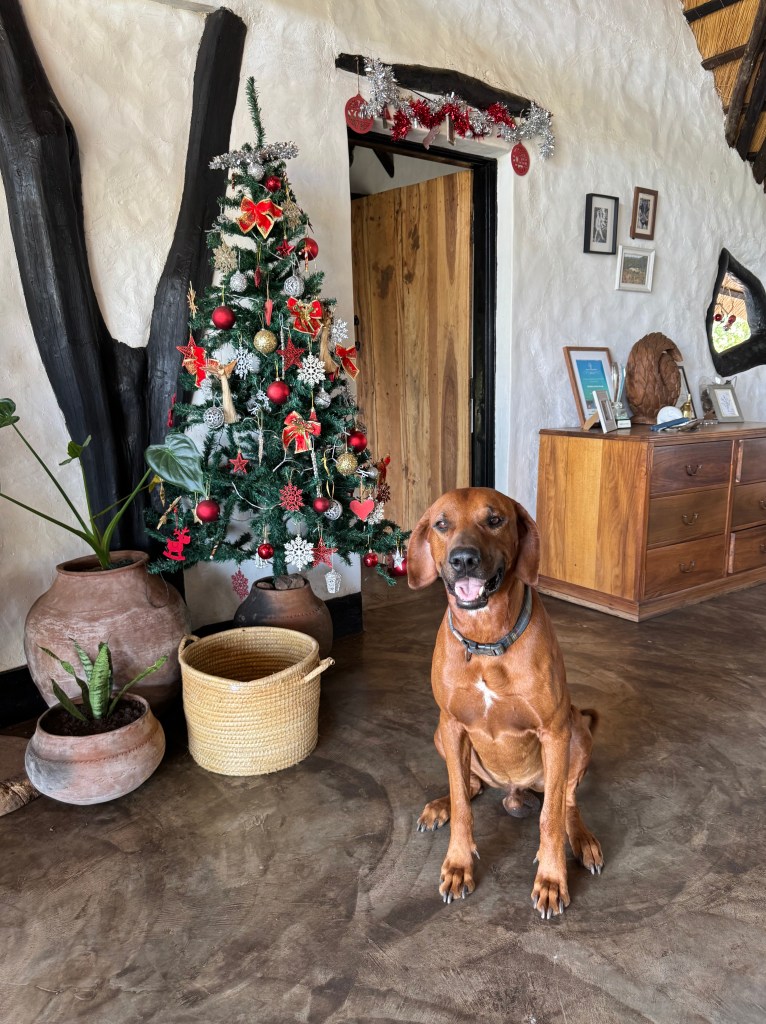
In an exclusive interview, brave canine cadet in the combat on poaching, Tarik, tells us about the dangers of life in the African bush–and why it’s worth the risk. After a concerning announcement was made by Wildlife Action Group and its partner organization, Elefence, on the rise of poaching in Malawi, we caught up with Tarik, one of WAG’s most devoted staff members, to learn more about the crisis. EB&MB: Tarik, thank you for taking the time to speak with the us about your mission in Malawi. After reading our interview with Dick Houston and Jon Stevenson of Elefence International last year, our readers may already be familiar with the work of Elefence and Wildlife Action Group in attempting to heal the poverty and poaching crisis which affects the lives of both people and animals in Africa today. However, we’d like to learn more from you about what life is really like on the ground for a WAG officer. Could you tell us a bit more about yourself? TARIK: “I’m a Rhodesian ridgeback, and my name means ‘Star,’ as I have a white 4 pointed patch on my chest which is somewhat typical of my breed. My sidekick, Lynn Clifford, is Field Manager for Wildlife Action Group, which is a Malawian non-profit conservation NGO. Our mission is to protect and restore Thuma and Dedza-Salima Escarpment Forest Reserves.” So how does your specific breed help you to carry out this mission? TARIK: “Well, my breed was originally developed in Rhodesia, now called Zimbabwe, where we were trained to hunt lions. So we can be really brave on the job. But actually, I myself had a very close call with a warthog. It was the last time Dick and Jon of Elefence were out here, and I can tell you, I learned a lesson the hard way. I took off chasing a warthog–because, you know, I can’t help myself–and unfortunately I came back with a large gash on my hindquarters. And that wasn’t my only close call. Here in Malawi, there are a couple of diseases carried by flies that are usually fatal to dogs. I barely survived one just before Dick and Jon arrived at the WAG base camp. The cure is almost as bad as the disease as they administer what is basically a poison to kill off the infection and many times the medicine kills the dog…but not me! Life is dangerous for a dog in the African bush, so I have to be brave, but my friend Jon says I’m just a big friendly puppy.” And as we’ve recently heard, life isn’t just dangerous for the dogs. Can you tell us about WAG Rangers’ recent encounter with poachers? TARIK: “Sadly, poaching is on the increase in Malawi and that keeps me and my co-worker, Lynn, busy on the job, trying to protect the special animals who live here and the forest they inhabit. It’s important to note that these poachers don’t hunt game for subsistence–no–it’s greed for profit. As Jon has told you before, pangolins, for instance, can be poached and sent as far away as China just to make a profit on the market for animal parts. And like pangolins, many of these animals–elephants, warthogs, kudus, duikers, and more —are threatened species, and on average a team of poachers can kill up to three animals each time they hunt! A huge loss for the Malawian government and the country’s prospects of being a tourism destination! It also touches me personally, because the poachers use dogs. The dogs track, hunt and catch the animal quickly which is then hacked and or speared to death by the poachers. I’m here to show that dogs can play a positive role in conservation. Between September and December 2024, our dedicated WAG rangers caught eleven dog poaching teams. I want to show that dogs can be on the right side of this war on wild animals.” And how do you help to play a positive role in supporting your fellow soldiers, Tarik? TARIK: “Well, I’m Field Manager Lynn’s constant companion. Basically, I’m her First Lieutenant. Together we make sure base camp is supplied and our rangers are supported. Poachers are aggressive and rangers are assaulted in the course of their duty! These rangers only make $3 bucks a day. That is why we rely on generous donors to keep these men in the field. Otherwise poachers would overrun the forest and kill more and more wild animals to oblivion.” WAG Rangers recently made several important arrests. Were any rangers injured in the line of duty? TARIK: “Yes, one of my ranger friends was badly injured, and I’m including a picture of him here just to show how brave he was. I knew how much that must hurt when I thought about my warthog gash. And poachers are scarier than warthogs. They go armed into the forest with dogs, bows, arrows and spears! They don’t understand what we’re trying to protect–but, like Nelson Mandela said, “If we do not do something to prevent it, Africa’s animals and the places in which they live will be lost to our world and her children forever.” So we are here taking these risks. Last week two suspects were arrested and this morning our brave anti-poaching rangers arrested 3 more, one being one of the most notorious poachers from Dedza who has been a very large thorn in our side all of this year! A second offender! All suspects have been handed over to the police for prosecution. Another win for our rangers!!” Tarik, our Head Biologist, who is both a dog lover and passionate conservationist, is concerned about the fate of the dogs involved in the poaching. What happens to them when the poachers get arrested? TARIK: “Many times the dogs escape when the owners are caught and run loose to kill again. Sadly the dogs that are caught must be euthanized. They have been trained to hunt and bring down game and are loyal to only one master. Lynn is a dedicated dog lover, and she and I are heartbroken that this step has to be taken but there is no hope of rehabilitating these dogs. It is our goal to make poaching with dogs so unprofitable and have such strict penalties that the practice will stop. Life is hard in the African bush–but it’s worth it.”
Interview conducted by Erin B. and Marianna B., with the assistance of Lynn Clifford of WAG and Jon Stevenson of Elefence.
At one time there was a theory put forth that elephants were telepathic. They seemed to be able control their actions when they could not see one another and neither did they make any noise. A herd would be spread out foraging when they would all stop and come together and move off in one direction. If there was a predator in the area they would gather and circle their babies to protect them. Well, we know now that they are not telepathic but they do communicate in ways we are only recently beginning to understand.
When Paula and I were on safari with Dick a few years ago, we were in a blind watching a small group of bulls at a water hole. We were within 15-20 feet of them which was exciting on its own but we could hear this low rumbling coming from different individuals. I asked our guide if that was their stomach growling and he replied “No, they are talking to one another”. I have learned since that elephant researchers have recorded these sounds and when played back they noted a reaction from specific individuals. They conclusion was that the sounds made related to a specific individual much like calling our someone’s name to a group.
Elephants are also known to communicate seismically – vibrations produced by impacts upon the earth. Foot stomping or false charges produce tremors which can be felt by other elephants up to 20 miles away.
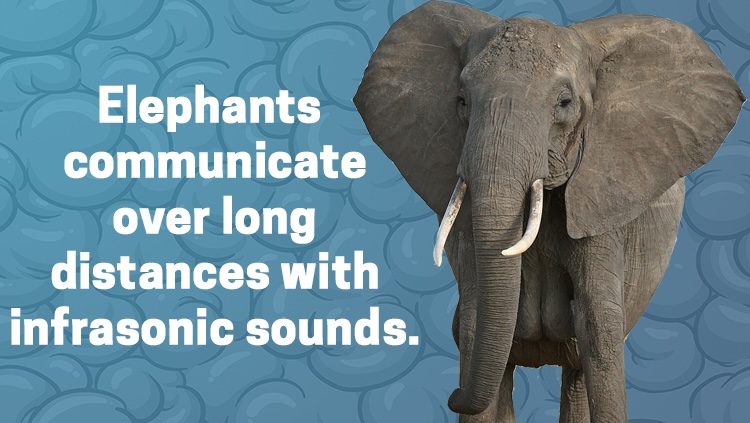
Surprisingly, elephants produce Ultra Low Frequency sounds that are below the range of human hearing. ULF sounds can travel long distances, up to 10 miles under the right conditions, both through the air as well as the ground. Other elephants can hear and interpret these sounds. Researchers have used special equipment to record these ULF sounds and have logged over 100 different sounds and combination of sounds made by elephants. We don’t know what they are saying yet, but there is no doubt that elephants do communicate.
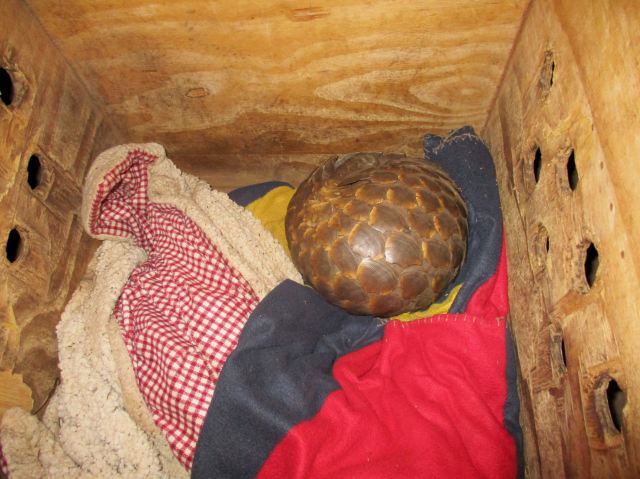
Pangolins, or scaly anteaters as they are often called, are one of nature’s oddest creatures. They have a small compact body covered with scales made of keratin which is the same material as our human fingernails. Pangolins are found in Asia and sub-Saharan Africa. They feed exclusively on ants and termites and roll up in a ball to protect themselves if they are threatened by a predator.
Pangolins are the most trafficked wild animals in the world, and are endangered due to poaching. Deforestation has also impacted their numbers. They are sold mainly into China where their scales and meat are touted to be a cure for everything from arthritis to warts. Their meat is consumed and the scales ground into a powder both of which bring very high prices on the black market.
When captured pangolins are intercepted by rangers and customs officials the pangolins are often undernourished and in poor condition due to injuries, With these problems they cannot be returned to the wild as they would not survive. Enter Elefence’s partner in Malawi, Wildlife Action Group which is an authorized pangolin rehab center. Any wounds are treated but the problem is how to feed them. Purina does not make pangolin chow.
The solution to getting them food is to take them into the bush and find rotten logs filled with ants and termite mounds. Dick and I were fortunate to go on one of the feeding sessions. A ranger put a blanket over his shoulder and draped the pangolin on it. In addition to the keeper there was a ranger who kept track of the pangolin feeding and another ranger to watch for elephants or Cape buffalos — two of the most dangerous animals in Thuma, especially when surprised on a forest trail. The rangers locate a rotten stump and set the pangolin in front of it. The pangolin immediately knew what to do and tore into the stump with their powerful front feet and long claws. They used their long sticky tongue to gather the insects and quickly bring them into their snout. After several feeding sessions the animal was returned to the WAG office where it would curl up and sleep off its meal. Elefence is proud to be a partner and supporter of WAG in their efforts to protect the two forest reserves and the animals which live in it.